
How to Use Nonverbal Cues to Strengthen Your Message


Table of Contents
- How to Use Nonverbal Cues to Strengthen Your Message
- What Is Nonverbal Communication?
- Why Is Nonverbal Communication Important?
- The Difference Between Verbal and Nonverbal Communication
- Using Nonverbal Communication Effectively
- Using Nonverbal Communication in Different Situations
- How to Improve Nonverbal Communication Skills
- The Science Behind Nonverbal Communication
- Fun Activities to Learn Nonverbal Communication
- Checkpoints for Students
- Nonverbal Cues and Their Meaning
- How to Use Nonverbal Cues to Strengthen Verbal Messages
- The Role of Nonverbal Communication in Building Confidence
- Common Mistakes in Nonverbal Communication
- Cultural Differences in Nonverbal Communication
- How Parents Can Help Children Improve
- The Role of Teachers in Developing Nonverbal Skills
- Real-Life Example
- Checkpoints for Parents
- Table: Use of Hands, Posture, and Eye Contact
- Using Nonverbal Communication in an Interview
- How Nonverbal Communication Builds Leadership Qualities
- About PlanetSpark : Personality Development
Have you ever noticed that sometimes people understand what you mean even before you say a word? That’s because your body, face, and gestures can also speak. This is called nonverbal communication. It is the way we send messages without words through facial expressions, hand movements, posture, eye contact, and even tone of voice. Nonverbal communication helps others understand our feelings and thoughts more clearly.
At PlanetSpark, we help children become confident communicators, not just by what they say, but also by how they say it. Learning to use nonverbal cues makes your message stronger, clearer, and more meaningful in school, at home, and later in life.
How to Use Nonverbal Cues to Strengthen Your Message
Nonverbal cues are the unspoken signals we use through body language, facial expressions, tone, and gestures to make our words more powerful. They help others understand not just what we say, but how we feel. Simple actions like maintaining eye contact, using open hand gestures, smiling, and standing tall can make your message clear and confident. When your words match your actions, people trust and connect with you. Whether in school, at home, or in conversations with friends, using positive nonverbal cues helps you express yourself better and build stronger, more respectful communication with everyone around you.
Book a free demo session to see how your child can become a strong and polite communicator.
What Is Nonverbal Communication?
Nonverbal communication means expressing yourself through actions instead of words. It includes everything from your smile to how you stand or move your hands while speaking.
Types of Nonverbal Communication
| Type | Example | What It Shows |
|---|---|---|
| Facial expressions | Smiling, frowning | Shows feelings like happiness or sadness |
| Gestures | Waving, thumbs up | Shows excitement, approval, or direction |
| Posture | Standing tall or slouching | Shows confidence or tiredness |
| Eye contact | Looking directly at someone | Shows attention and respect |
| Tone of voice | Calm, loud, or soft | Shows emotions and confidence |
| Appearance | Clean and tidy clothing | Shows responsibility and respect |
Even when you are silent, your body keeps talking. That’s why understanding and improving nonverbal cues is important.
Why Is Nonverbal Communication Important?
Nonverbal cues make your message powerful and help people trust and understand you better.
Importance for Students
Helps you speak confidently during presentations.
Makes friends feel comfortable while talking to you.
Improves teamwork during group projects.
Helps teachers see your interest in learning.
Importance for Parents
Builds stronger connections with children.
Helps communicate emotions clearly even without words.
Creates a positive and respectful atmosphere at home.
The Difference Between Verbal and Nonverbal Communication
Verbal communication means using words to express your ideas, while nonverbal communication means expressing yourself through actions, expressions, and tone.
Both are important, but they play different roles in making others understand your message clearly.
| Type | Example | Purpose |
|---|---|---|
| Verbal | Speaking, writing | To share thoughts and facts clearly |
| Nonverbal | Body language, gestures, facial expressions | To show feelings and emotions |
Verbal communication helps people know what you are saying, while nonverbal communication helps them understand how you feel about it.
For example, if you say, “I’m fine” but frown and cross your arms, people might not believe your words. When your words and actions match, your message becomes strong and trustworthy.
Read more articles on communication and personality growth at PlanetSpark.
Using Nonverbal Communication Effectively
To make your communication better, you must use both verbal (words) and nonverbal (actions) cues together. Here’s how to do that effectively.
1. Maintain Eye Contact
Eye contact shows confidence, honesty, and interest. When you talk to someone, look at them gently instead of looking down or away.
In school, looking at your teacher while answering shows that you are paying attention.
2. Use Hand Gestures
Hand movements help explain what you are saying. For example:
Open hands show friendliness.
Pointing can show direction.
Small hand motions can help describe size or distance.
But remember, do not wave your hands too much or too close to someone’s face. It might look distracting.
3. Keep a Positive Posture
Posture means the way you hold your body. Standing or sitting straight shows confidence and respect.
Leaning forward slightly when listening shows interest and involvement.
| Posture Type | What It Shows | When to Use |
|---|---|---|
| Standing tall | Confidence | During public speaking |
| Leaning forward | Engagement | When listening to someone |
| Relaxed shoulders | Calmness | During casual talks |
4. Smile Naturally
A simple smile can make people feel comfortable. It shows that you are friendly and open to communication.
However, forced smiles look fake. Try to smile when you genuinely feel positive.
5. Use Voice Tone Wisely
Your voice can change the meaning of your words.
Saying “Thank you” in a warm tone sounds polite. But saying the same words in a flat or angry tone sounds rude.
Practice using a calm, clear, and confident tone.

Using Nonverbal Communication in Different Situations
In Class or School
Raise your hand to show you want to speak.
Nod your head when you understand something.
Sit upright to show interest.
Smile when greeting teachers or classmates.
At Home
Make eye contact when talking to your parents.
Use open hands while explaining something.
Keep your body relaxed when listening to others.
In a Presentation
Stand straight and look at your audience.
Use hand gestures to highlight points.
Walk slowly and confidently if needed.
Avoid crossing your arms or looking nervous.
In an Interview
Interviews are not just about what you say but also how you behave.
| Nonverbal Cue | Meaning |
|---|---|
| Firm handshake | Confidence |
| Eye contact | Respect and honesty |
| Straight posture | Professionalism |
| Calm tone | Maturity and control |
If you smile, listen carefully, and maintain good posture, interviewers will see you as confident and positive.
How to Improve Nonverbal Communication Skills
Improving your nonverbal skills takes practice, patience, and awareness. Here are some easy ways.
1. Practice in Front of a Mirror
Watch your facial expressions and posture while talking.
Check if your expressions match your words.
2. Record Yourself Speaking
Recording helps you see your gestures, voice, and body language. You can notice if you move too much or avoid eye contact.
3. Observe Others
Watch teachers, leaders, or presenters. Notice how they use hand gestures, posture, and expressions.
4. Ask for Feedback
Ask your parents or friends to tell you how your body language looks when you talk.
5. Practice Role Plays
Pretend you are in real situations like answering in class or giving an interview. This helps you become more natural and confident.
The Science Behind Nonverbal Communication
Did you know that scientists say more than half of communication happens without words? Studies show that people understand your emotions more from your tone and body language than your actual words.
This happens because our brains quickly read expressions, gestures, and tone to guess feelings and intentions.
For example:
Raised eyebrows often mean surprise.
A firm voice means confidence.
Crossed arms can show discomfort.
Learning how the brain interprets these signals helps you control your body language better and send the message you truly want to share.
Fun Activities to Learn Nonverbal Communication
Activity 1: The Silent Movie
Act out a short scene (like a morning routine) without using words. Others must guess what you are doing by watching your actions.
This helps children understand how powerful body language can be.
Activity 2: The Mirror Game
Stand in front of a mirror. Practice different emotions happiness, anger, surprise, sadness using only your face.
This helps you control facial expressions.
Activity 3: Guess the Gesture
In this game, one person uses gestures to show a message, and others guess what it means.
For example, showing a thumbs-up for “good job” or waving for “hello”.
Checkpoints for Students
| Checkpoint | Question to Ask Yourself |
|---|---|
| Eye Contact | Am I looking at the person I’m talking to? |
| Posture | Am I standing or sitting straight? |
| Hands | Are my gestures natural and clear? |
| Face | Does my expression match my words? |
| Tone | Am I speaking calmly and clearly? |
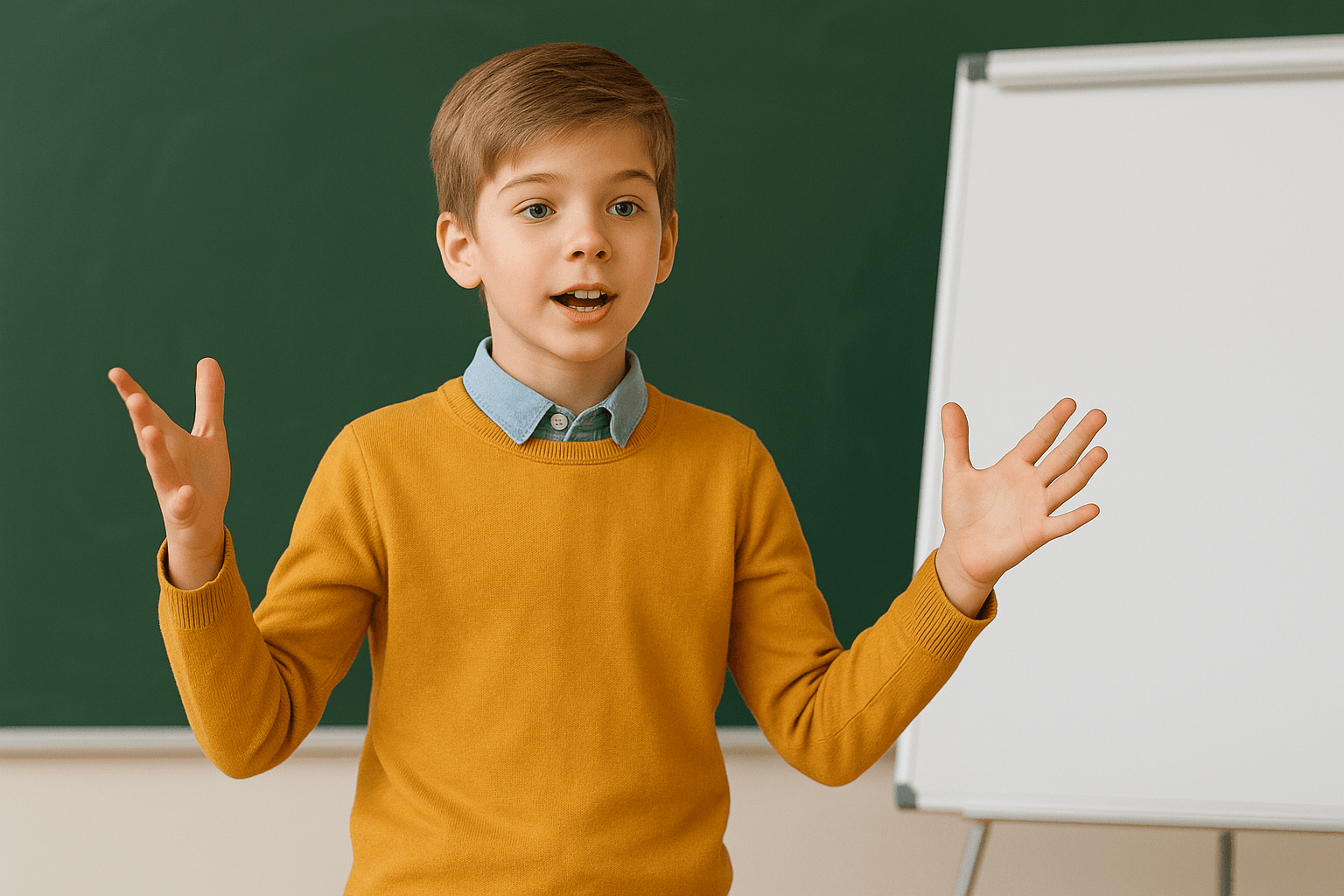
Nonverbal Cues and Their Meaning
| Nonverbal Cue | Description | Meaning |
|---|---|---|
| Eye Contact | Looking directly at someone while speaking | Confidence |
| Hand Movements | Gestures while talking | Energy and involvement |
| Posture | Body position | Confidence or nervousness |
| Facial Expression | Movements of eyes, mouth, and face | Emotions |
| Space | How close you stand to someone | Comfort and respect |
| Touch | Handshake, pat on back | Warmth and connection |
These signals help people understand your mood and message better.
Start your child’s journey to confidence, clarity, and leadership : book a free trial class now!”
How to Use Nonverbal Cues to Strengthen Verbal Messages
Words alone are not enough. When your actions and words match, your message becomes powerful.
Step-by-Step Tips
Plan your speech and think about your gestures.
Use natural hand movements to highlight important points.
Keep your face relaxed and expressive.
Match your tone with your message (excited, calm, serious).
Pause sometimes to show importance and let others think.
For example:
When saying “I’m confident,” stand straight with a steady voice.
When saying “I’m sorry,” use a gentle tone and soft expression.
When your body and words agree, people believe your message more easily.
The Role of Nonverbal Communication in Building Confidence
Confidence is not only shown by your words but also through your posture, expressions, and gestures. Even before you speak, people form an impression based on your body language.
Confident people:
Stand straight and look relaxed.
Maintain eye contact.
Use clear gestures.
Smile naturally.
If you look nervous or avoid eye contact, your message may seem weak, even if your words are correct.
That is why at PlanetSpark, students learn how to combine confidence with politeness through positive body language. It helps them perform better in speeches, storytelling, and interviews.
Common Mistakes in Nonverbal Communication
| Mistake | Effect |
|---|---|
| Crossing arms | Looks defensive or uninterested |
| Avoiding eye contact | Seems shy or unsure |
| Speaking too fast | Sounds nervous |
| Frowning or rolling eyes | Appears rude |
| No gestures | Looks dull or bored |
Be aware of these signs and try to correct them through practice.
Cultural Differences in Nonverbal Communication
Nonverbal communication can mean different things in different cultures. A gesture that seems friendly in one country might be confusing in another.
| Gesture | Meaning in Some Countries | Different Meaning Elsewhere |
|---|---|---|
| Thumbs up | Good or okay | Rude gesture in some countries |
| Eye contact | Respectful | Disrespectful in some Asian cultures |
| Nodding head | Agreement | “No” in some parts of the world |
This shows that understanding culture is important when using nonverbal cues. Children who learn cultural awareness become better global communicators.
At PlanetSpark, students explore communication from different cultures to build empathy and understanding.
How Parents Can Help Children Improve
Parents play a big role in helping kids learn how to communicate effectively.
Be role models by showing good eye contact and positive posture.
Encourage children to express emotions through gestures.
Give feedback kindly when their body language seems unclear.
Praise confident and polite communication.
Practice together during conversations or storytelling.
The Role of Teachers in Developing Nonverbal Skills
Teachers also play a key role in helping children learn how to use body language effectively. In classrooms, teachers notice students’ posture, eye contact, and expressions to understand their comfort and confidence levels.
Teachers can:
Use gestures and expressions to keep lessons engaging.
Encourage students to express ideas confidently.
Provide feedback on posture and tone during speaking activities.
Include drama and role-play to improve natural body language.
When teachers and parents work together, children learn to communicate confidently in every environment.
Real-Life Example
Riya was a bright student but often looked nervous while presenting in class. Her teacher suggested she focus on her nonverbal cues. She practiced standing straight, smiling, and looking at her audience.
Within weeks, Riya became one of the most confident speakers in her class. Her message was strong not just because of her words but also because of her expressions and posture.
Checkpoints for Parents
| Checkpoint | Action |
|---|---|
| Observe | Watch how your child speaks and moves. |
| Encourage | Appreciate good posture and expression. |
| Guide | Teach them to stay calm and polite. |
| Practice | Use games to teach nonverbal skills. |
| Model | Show them how confident people communicate. |
Table: Use of Hands, Posture, and Eye Contact
| Nonverbal Cue | Example | What It Shows |
|---|---|---|
| Use of hands | Open palms while speaking | Honesty and openness |
| Directive posture | Leaning forward slightly | Attention and interest |
| Eye contact | Looking directly at the person | Confidence and trust |
These three simple cues can make your message more powerful anywhere in school, at home, or in an interview.
Using Nonverbal Communication in an Interview
In interviews, your body language can say more than your words.
Greet with a polite smile and firm handshake.
Sit upright with your hands resting naturally.
Maintain gentle eye contact with the interviewer.
Nod occasionally to show understanding.
Avoid crossing your arms or fidgeting.
These simple behaviors show that you are confident, respectful, and ready for the opportunity.
How Nonverbal Communication Builds Leadership Qualities
Leaders are not just good speakers they are great communicators. Nonverbal communication plays a huge role in leadership development.
A good leader:
Listens actively with eye contact.
Uses gestures to motivate the team.
Shows confidence through posture and calm tone.
Inspires others with their presence.
When students learn how to control their body language, they also learn leadership qualities such as confidence, respect, and emotional awareness. These skills help them become strong, empathetic leaders in school and life.
About PlanetSpark : Personality Development
PlanetSpark helps children become confident, expressive, and emotionally intelligent individuals through engaging 1:1 live classes. Our Personality Development Program nurtures communication, confidence, body language, and leadership empowering kids to shine in every situation, from classrooms to public stages.
1. 1:1 Expert Mentorship
Every learner is guided by a certified personality coach who tailors each session to their strengths, goals, and pace ensuring focused growth and visible transformation.
2. Personalised Growth Roadmap
Each child follows a customised plan designed to build self-awareness, positive mindset, emotional balance, and social confidence step by step.
3. AI-Powered Confidence Insights
With SparkX and AI-led assessments, students receive instant feedback on voice modulation, facial expressions, and confidence levels turning practice into real improvement.
4. Interactive & Experiential Learning
Fun and engaging modules like Confidence Quests, Social Savvy Challenges, and Expression Labs help kids develop interpersonal and leadership skills through roleplays and games.
5. Confidence for Every Stage of Life
From classroom interactions to public speaking and teamwork, children learn to communicate effectively, handle challenges gracefully, and lead with confidence.
Frequently Asked Questions
Nonverbal cues are signals we send through body language, expressions, or gestures to communicate without words.
It makes your message clearer, builds trust, and shows emotions more effectively.
Use good posture, eye contact, hand gestures, and tone of voice to match your words.
Practice in front of a mirror, observe confident speakers, and take feedback from others.
PlanetSpark offers live classes where children learn to communicate clearly using both verbal and nonverbal skills.