
Academic-to-Industry Summary Bank

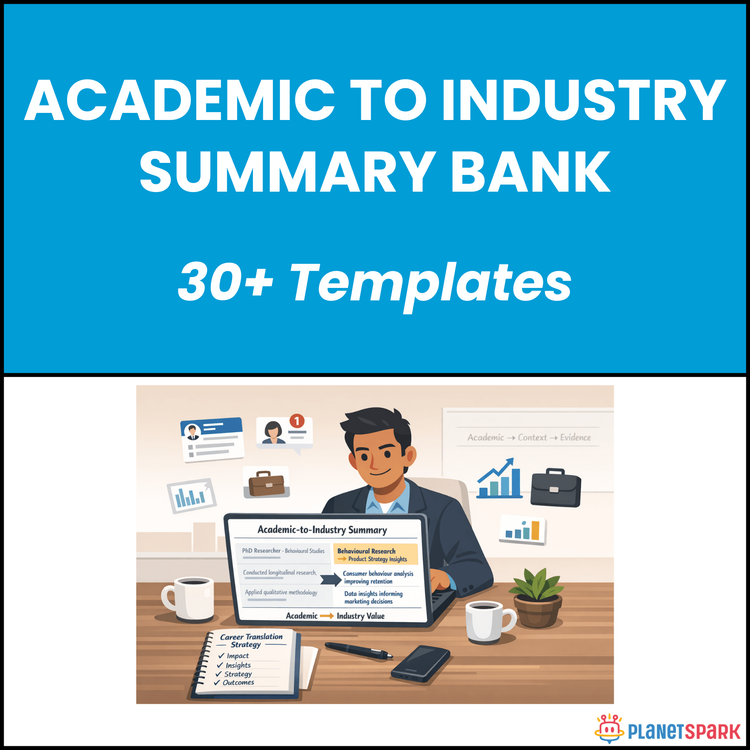
Academic-to-Industry Summary Bank
Academic to Industry Translation Guide: 30+ Templates for LinkedIn, Resume, and Interviews
Many highly skilled professionals face the same frustrating problem when trying to move from academia into industry.
They have years of research experience, deep analytical skills, and strong subject expertise. Yet when they apply for industry roles, consulting projects, or leadership positions, their profiles often fail to resonate with hiring managers.
The reason is rarely a lack of ability.
The real issue is language.
Academic training teaches professionals to describe their work in terms of methodology, theory, and process. Industry leaders, on the other hand, are focused on outcomes, business impact, and decisions. When the language doesn’t match the audience, even impressive experience can be misunderstood or overlooked.
The Academic-to-Industry Summary Bank was created to solve this exact problem. This resource provides more than 30 ready-to-use templates that help professionals translate academic credentials into language that hiring managers, clients, and stakeholders understand immediately.
Instead of rewriting your entire career story from scratch, the templates help you reframe your expertise so that its real value becomes clear.
If you are transitioning from academia to industry, consulting, or leadership roles, this resource gives you a structured way to present your experience in a way that drives opportunities.
Who Is This Resource For?
This resource is especially valuable for professionals who need to translate academic or research experience into practical industry language.
It is designed for:
• PhD graduates and postdoctoral researchers transitioning into industry roles
• Academics moving into consulting, strategy, product, or business functions
• Professionals with graduate degrees who want to position their academic expertise effectively
• Career switchers who need to explain transferable skills clearly
• Consultants and advisors with research backgrounds pitching to clients
• Early- to mid-career professionals (0–15 years of experience) looking to strengthen their professional narrative
If you have ever felt that your experience is stronger than your resume or LinkedIn profile suggests, this resource is designed for you.
What Does This Resource Contain?
The Academic-to-Industry Summary Bank is a comprehensive toolkit designed to help professionals translate their experience across multiple career contexts.
Inside the resource, you will find:
LinkedIn Profile Templates
These templates help professionals craft compelling headlines and summaries that communicate their value quickly. The resource emphasizes that LinkedIn headlines should clearly communicate what you do, who you help, and what outcome you create.
Resume Summary Templates
Professionals learn how to replace traditional academic CV openings with concise value-driven summaries designed for recruiters who scan resumes in seconds.
Bullet Point Translation Examples
The resource shows how to convert academic language into business-focused impact statements. For example, a research description can be reframed as a measurable business insight that influenced decisions.
Cover Letter Templates
Short, practical frameworks help professionals open cover letters with relevance and impact rather than long academic introductions.
Elevator Pitch Templates
The guide provides structured templates to help professionals explain their background confidently in networking conversations, interviews, or meetings.
Professional Bio Templates
Professionals can quickly generate short, medium, or long bios suitable for speaking events, consulting profiles, and company websites.
Consulting Proposal Language
The resource includes templates for framing problem statements, methodology descriptions, and measurable outcomes in client proposals.
Interview Answer Frameworks
Using the widely adopted STAR method (Situation, Task, Action, Result), professionals learn how to frame academic experiences in ways that resonate with hiring panels.
Worksheets and Checklists
The resource includes practical worksheets such as the ACE Translation Map, which helps professionals translate academic experience into industry context and measurable outcomes.
Summary of the Resource
At its core, the Academic-to-Industry Summary Bank solves one of the most common career transition challenges: explaining academic expertise in a way that industry understands.
The entire resource is built around a simple but powerful structure called the ACE Framework:
Academic → Context → Evidence.
This framework teaches professionals how to:
• Start with their academic expertise
• Connect it to a real-world business context
• Demonstrate measurable outcomes or impact
Once professionals understand this structure, they can apply it to LinkedIn profiles, resumes, consulting proposals, interviews, and networking conversations.
Instead of rewriting their background, they simply reframe it.
How Will This Resource Be Useful?
Professionals who apply the templates in this resource gain several practical advantages.
Clarity in Professional Positioning
Many professionals struggle to explain how their academic work connects to real-world business problems. This resource provides the language to make that connection clearly.
Stronger Job Applications
Recruiters typically spend only a few seconds scanning a resume during the first review. A strong summary and outcome-focused bullet points dramatically improve the chances of getting noticed.
More Effective Networking
Elevator pitch templates help professionals explain their work clearly in conversations, networking events, and interviews.
Higher Credibility
Quantifying outcomes and translating research into impact statements increases perceived credibility with hiring managers and clients.
Better Career Transitions
Whether moving into consulting, product management, strategy roles, or leadership positions, professionals can frame their background as an asset rather than a barrier.
Ultimately, the resource turns academic expertise into a professional advantage rather than something that needs to be “explained.”
How Should You Use This Resource?
The resource is designed to be applied step-by-step rather than read passively.
Start with the ACE Framework
Begin by understanding the Academic → Context → Evidence model. This structure forms the foundation for all templates in the guide.
Complete the Translation Worksheet
Use the ACE Translation Map worksheet to identify three key academic experiences and translate them into business outcomes.
Update Your Core Profiles
Apply the templates to improve your LinkedIn headline, About section, and resume summary.
Translate Your Bullet Points
Rewrite academic descriptions into impact-driven statements using action verbs and measurable outcomes.
Prepare Your Pitch and Interview Answers
Use the elevator pitch templates and STAR interview frameworks to practise explaining your background in conversation.
Use the Checklists Before Applications
Before submitting job applications or consulting proposals, review your materials using the translation checklist included in the resource.
By following this process, professionals can gradually update every part of their professional narrative.
Action Steps
If you want to start using this resource immediately, follow these simple steps.
1. Identify three academic experiences that demonstrate your strongest skills.
2. Use the ACE framework to translate them into business outcomes.
3. Update your LinkedIn headline using the provided templates.
4. Rewrite your resume summary to highlight value instead of credentials.
5. Translate at least three bullet points on your resume into measurable achievements.
6. Practise a 30–60 second elevator pitch describing your background.
7. Apply the translation checklist before sending your next job application.
These small updates can dramatically improve how hiring managers and clients perceive your experience.
Your academic background is not a disadvantage.
It simply needs the right language.
Professionals who succeed in industry transitions are rarely the ones with the most credentials. They are the ones who communicate their value most clearly.
When you learn to translate your expertise into outcomes, your experience becomes immediately relevant to employers, clients, and decision-makers.
The templates in this resource provide the structure. Your insights and experience provide the substance.