
Building a Personal Communication Flywheel for Continuous Improvement

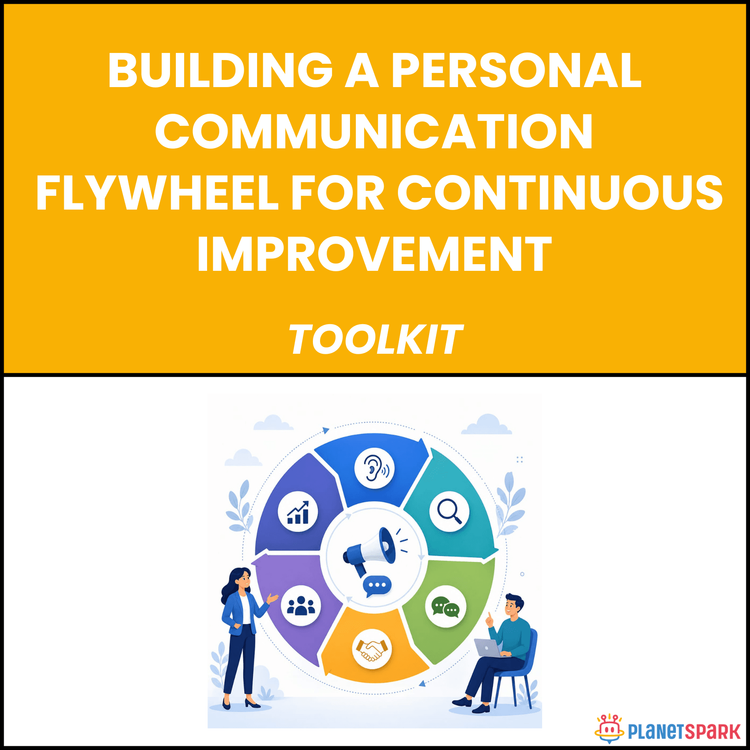
Building a Personal Communication Flywheel for Continuous Improvement
Personal Flywheel for Continuous Improvement: A Practical Toolkit for Working Professionals
Most professionals treat communication as a problem to solve once — a course to complete, a book to read, a workshop to attend. But communication is not a destination. It is a dynamic, living skill that either compounds over time or quietly erodes. The professionals who communicate most powerfully are not necessarily the most naturally gifted — they are the ones who have built a system for continuous improvement.
That system is what we call the Personal Communication Flywheel. Like a mechanical flywheel that stores rotational energy and keeps a machine running smoothly, your communication flywheel builds momentum through consistent, deliberate practice. Each conversation, presentation, email, or meeting becomes an opportunity to spin the wheel a little faster.
Prepare
Practice
Perform
Reflect
Workplace Presentation Scripts: A Practical Guide to Speaking with Confidence, Clarity, and Impact at Work
Most professionals spend hours perfecting slides—and only minutes thinking about what they will actually say.
That’s where things fall apart.
You may have strong ideas, solid data, and a well-designed deck. But without clear structure, confident delivery, and the right words at the right moment, your message gets lost. You ramble, miss key points, or fail to make a strong ask.
And in high-stakes workplace moments—project updates, client pitches, leadership reviews—that gap can cost you visibility, credibility, and opportunities.
This is exactly why the Workplace Presentation Scripts playbook exists. It gives you ready-to-use frameworks, scripts, and templates so you don’t just present—you influence decisions, drive outcomes, and leave a lasting impression.
Who Is This Resource For?
This playbook is designed for working professionals who want to communicate more effectively in high-impact situations. It is especially useful for:
- Early to mid-career professionals (0–15 years of experience)
- Career switchers stepping into new roles or industries
- Consultants and client-facing professionals
- Managers leading team updates or stakeholder meetings
- Professionals who feel confident about their content but struggle with delivery
- Anyone who wants to sound more structured, clear, and persuasive while presenting
If you’ve ever thought, “I know what I want to say, but I don’t know how to say it,” this resource is built for you.
What Does This Resource Contain?
The Workplace Presentation Scripts playbook is not theory—it is a practical, ready-to-use toolkit. It covers the most common presentation scenarios professionals face and gives you exact scripts and structures for each.
Here’s what you’ll find inside:
1. The Core Framework of High-Impact Presentations
- A simple three-layer structure: Core Idea, Structural Logic, and Delivery Design
- Clear breakdown of how to build presentations that drive decisions—not just share information
- Guidance on scripting openings, transitions, and closings
2. Script Templates for Key Workplace Scenarios
The playbook includes structured scripts for five critical presentation types:
- Project Update Presentations
Learn how to clearly communicate progress, highlight risks, and make specific asks without overloading your audience.
- Business Case / Pitch Presentations
A persuasion-focused framework to help you secure approvals, budgets, or buy-in by structuring your argument effectively.
- Data & Insights Presentations
Techniques to present data in a way that leads to decisions—using clear conclusions and focused storytelling.
- Q&A Handling Scripts
Practical responses for difficult, vague, or challenging questions so you maintain control and credibility.
3. Real-World Script Examples
- Worked examples that show how strong scripts sound in real situations
- Before-and-after phrasing to improve clarity and impact
4. Common Mistakes and Proven Fixes
- Weak openings, unclear asks, overloading with data, defensive responses
- Exact script adjustments to fix each mistake immediately
5. Pre-Presentation Checklist & Reflection Worksheet
- A structured checklist to prepare before any presentation
- A reflection framework to improve after every presentation
- Focus on continuous improvement and consistency
Summary of the Resource
This playbook is a complete, repeatable system for planning and delivering effective workplace presentations.
Instead of guessing what to say or improvising under pressure, you get:
- Clear scripts for opening, structuring, and closing presentations
- Frameworks for different scenarios like updates, pitches, and data reviews
- Ready responses for Q&A situations
- A preparation and reflection system to improve over time
In short, it helps you move from “sharing information” to “driving decisions.”
How Will This Resource Be Useful?
The real value of this playbook lies in the outcomes it enables.
When you apply these scripts and frameworks, you can:
- Speak with clarity and structure, even under pressure
- Reduce filler words, rambling, and confusion
- Communicate key messages faster and more effectively
- Make confident, specific asks that drive action
- Handle questions without losing composure or credibility
- Build a reputation as someone who is prepared, sharp, and impactful
Over time, this directly impacts your career by improving how you are perceived in meetings, reviews, and leadership interactions.
Because in most workplaces, how you present matters just as much as what you present.
How Should You Use This Resource?
To get the most value from this playbook, use it actively—not passively.
Follow this simple approach:
1. Read Through Once
Go through the entire playbook to understand the frameworks, scripts, and structure.
2. Match It to Your Next Presentation
Identify an upcoming presentation—project update, pitch, or data review—and choose the relevant script template.
3. Fill in the Templates
Replace placeholders with your actual content:
- Project name
- Key metrics
- Risks and recommendations
- Specific ask
4. Script Your Opening and Closing
Write your first and last 30 seconds word-for-word. These are the most critical moments.
5. Rehearse Aloud
Practice speaking your script at least twice. Silent reading does not translate into confident delivery.
6. Prepare for Q&A
Identify likely questions and use the provided scripts to prepare clear, confident responses.
7. Reflect After Delivery
Use the reflection worksheet to evaluate:
- What worked well
- Where you lost clarity or confidence
- What you will improve next time
This cycle—prepare, deliver, reflect—is where real improvement happens.
Action Steps
If you want to start seeing immediate results, take these steps right away:
1. Identify your next important presentation in the next 2–4 weeks
2. Choose one script template from the playbook
3. Write your opening and closing word-for-word
4. Define your “ask” clearly and early
5. Rehearse your script aloud at least twice
6. Prepare answers to the top 3 likely questions
7. Use the reflection worksheet within 24 hours after presenting
These small, structured actions will dramatically improve your confidence and performance.
The difference between average presenters and high-impact professionals is not talent—it is preparation.
Every time you use this playbook, you build a repeatable system for clarity, confidence, and influence. Over time, this compounds into stronger communication, better opportunities, and faster career growth.
If you want to be taken seriously in any room, start by taking your preparation seriously.