
Cover Letter Alignment With Job Description Worksheet

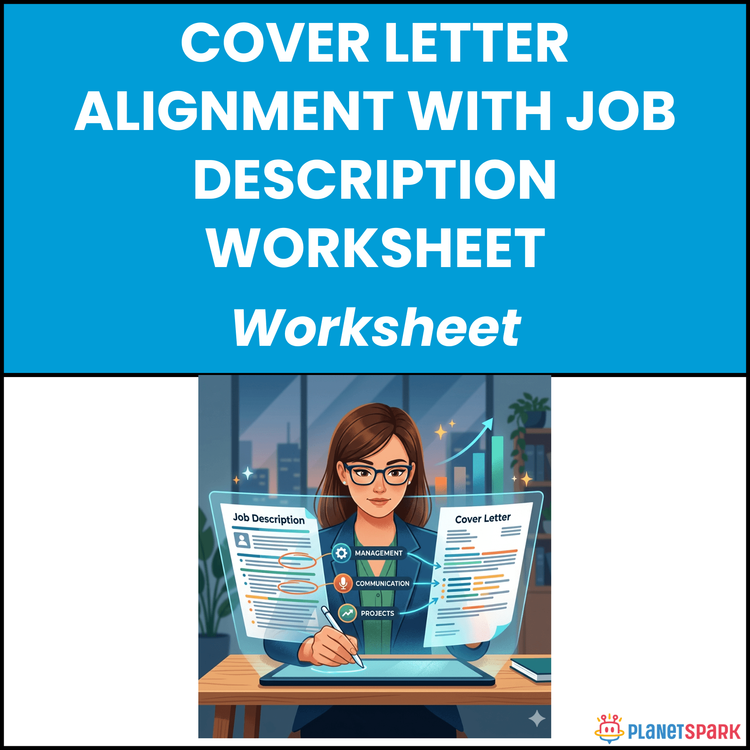
Cover Letter Alignment With Job Description Worksheet
How to Write Highly Targeted Cover Letters
If you’ve been sending out multiple job applications but not getting interview calls, the problem may not be your experience—it’s your alignment.
Most cover letters fail for one simple reason: they are written from the candidate’s perspective, not the employer’s. They talk about achievements, summarise resumes, and use generic language that could apply to any role. But hiring managers are asking a very specific question—“Why are you the right fit for this role, right now?”
That’s exactly why the resource “Cover Letter Alignment with Job Description Worksheet” exists. It’s built to help working professionals stop sending generic applications and start crafting highly targeted, role-specific cover letters that clearly demonstrate fit.
This worksheet doesn’t just help you write—it helps you think like a hiring manager.
Who Is This Resource For?
This resource is especially valuable if you are:
- A working professional with 0–15 years of experience
- A job seeker struggling to tailor cover letters for each application
- A career switcher trying to connect past experience with new roles
- A professional returning to the workforce after a break
- Someone applying to competitive roles where differentiation matters
- Anyone tired of writing cover letters that feel repetitive and ineffective
If you want every application to feel intentional, relevant, and aligned with what employers are actually looking for, this resource is built for you.
What Does This Resource Contain?
This is not a generic writing guide—it’s a structured worksheet that walks you through a repeatable, high-impact process.
Inside the resource, you’ll find:
- A clear breakdown of why most cover letters fail and what alignment actually means
- A three-pass job description decoding method (impression, verbs, categorisation)
- A detailed Job Description Decoder worksheet to map requirements to your experience
- A framework to identify the employer’s core problem and position yourself as the solution
- Techniques to write strong, problem-led opening paragraphs
- A strategic language mirroring system to match employer vocabulary naturally
- A language mapping worksheet to build your own phrase bank
- A proven four-paragraph cover letter structure (Hook, Evidence, Culture Fit, Close)
- Guidance on writing evidence-driven, role-relevant achievement statements
- A comprehensive alignment audit checklist (Content, Language, Tone)
- Real-world case studies showing transformation from generic to targeted letters
- Common mistakes professionals make—and how to fix them immediately
- The PAR-JD framework (Problem, Action, Result + Job Description link) for building strong sentences
- A self-evaluation scoring system to assess your cover letter objectively
- A quick-reference cheat sheet for faster future applications
Every section is designed for direct application, not passive reading.
Summary of the Resource
“Cover Letter Alignment with Job Description Worksheet” is a practical, execution-focused guide that helps professionals write highly targeted cover letters by decoding job descriptions and aligning their experience accordingly.
It teaches you how to understand what the employer really wants, translate your background into their language, and present your value in a structured, convincing way.
If you invest a few focused hours, you’ll not only improve one application—you’ll build a repeatable system for every job you apply to.
How Will This Resource Be Useful?
This resource helps you move from guesswork to precision.
You’ll gain:
- Clarity on how to interpret job descriptions beyond surface-level reading
- The ability to identify what employers truly prioritise
- Strong, tailored cover letters that directly address role requirements
- Confidence in positioning your experience as a clear solution
- Improved alignment with ATS systems and recruiter expectations
- Faster and more effective application processes
- Higher chances of getting shortlisted for interviews
Most importantly, it helps you stop applying broadly—and start applying strategically.
How Should You Use This Resource?
To get the best results, follow a structured workflow:
Start by using the three-pass method to decode the job description. Read once for context, once for action verbs, and once to categorise requirements into must-haves, nice-to-haves, and cultural signals.
Next, identify the employer’s core problem. Ask yourself why this role exists and what challenge the company is trying to solve.
Then, map your experience using the provided worksheets. Align your past work with the job description using the same language and terminology.
Build your cover letter using the four-paragraph structure:
- Start with a strong, problem-led hook
- Add 2–3 evidence-based achievements aligned to key requirements
- Show clear understanding of company culture or priorities
- Close with a confident, action-oriented statement
Before submitting, run the alignment audit checklist. Evaluate your letter across content, language, and tone to ensure it meets professional standards.
With practice, this process becomes faster and highly repeatable.
Action Steps
After accessing this resource, take these steps immediately:
1. Choose one job description you are actively applying for
2. Complete the three-pass decoding exercise
3. Fill out the Job Description Decoder worksheet
4. Write one clear sentence defining the employer’s core problem
5. Build 3–4 PAR-JD statements based on your experience
6. Draft your cover letter using the four-paragraph structure
7. Run the alignment audit checklist before submitting
Focused effort on one application can significantly improve your results.
A strong cover letter is not about writing more—it’s about aligning better. When your language reflects the employer’s needs, your examples prove relevance, and your structure makes it easy to read, you reduce friction in the hiring decision.
Use this resource not just to improve your cover letters, but to sharpen how you think about your professional value and communicate it with clarity and confidence.
Book your free session today!