
Cover Letter Narrative Development Worksheet

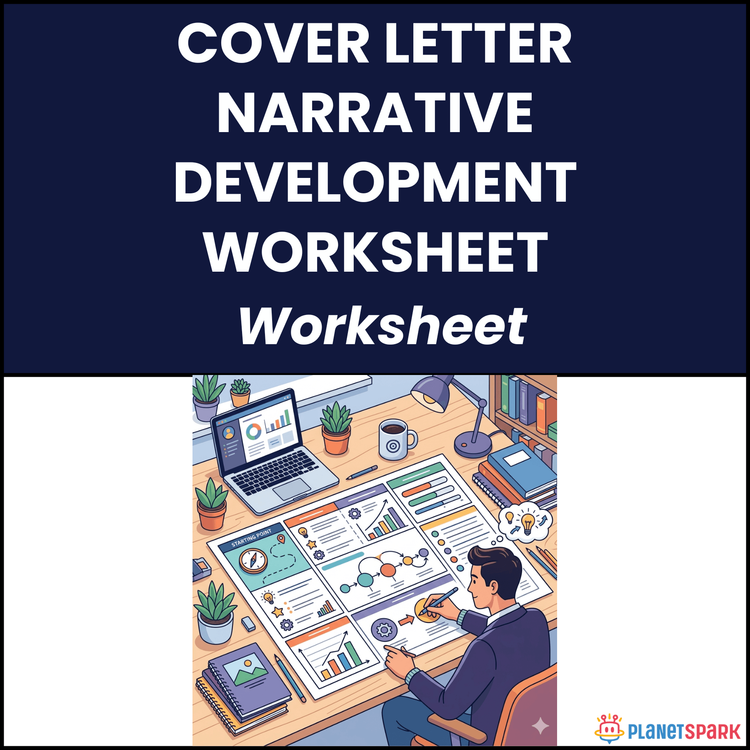
Cover Letter Narrative Development Worksheet
How to Write a Powerful Cover Letter
Most professionals treat cover letters as a formality—something to quickly complete before hitting “apply.” The result? Generic, repetitive letters that echo the resume and fail to create any real impact.
If you’ve ever wondered why your applications don’t convert into interviews despite being qualified, your cover letter might be the missing link.
The resource “Cover Letter Narrative Development Worksheet” is designed to solve exactly this problem. Instead of focusing on templates or surface-level phrasing, it helps you build a compelling, structured narrative that positions you as the right candidate—clearly, confidently, and strategically.
This is not about writing more. It’s about writing with intent.
Who Is This Resource For?
This worksheet is especially useful if you are:
- A working professional with 0–15 years of experience
- A job seeker struggling to stand out in competitive roles
- A career switcher trying to justify a transition clearly
- A consultant or specialist positioning your expertise for new opportunities
- A mid-career professional aiming for leadership or strategic roles
- Someone who finds cover letters confusing, repetitive, or ineffective
If you are outcome-driven, short on time, and want your application to actually get noticed, this resource is built for you.
What Does This Resource Contain?
This is a structured, step-by-step worksheet designed for practical execution—not passive reading.
Inside, you’ll find:
- A clear explanation of why cover letter narratives matter more than formats
- A self-clarity framework covering:
- Professional identity
- Value proposition
- Motivation truth
- A strategic method to decode job descriptions beyond surface-level requirements
- A three-act narrative structure (Hook, Evidence, Forward Momentum)
- Guided prompts to build each section of your cover letter
- A detailed approach to writing a strong opening hook
- The STA framework (Situation, Transformation, Achievement) for proof points
- Exercises to select and refine relevant career examples
- A structured approach to writing a compelling closing paragraph
- Real-world before-and-after examples of cover letter transformation
- A list of common cover letter mistakes and how to fix them
- A comprehensive audit checklist to evaluate your final draft
- A practical 48-hour action plan to move from worksheet to application
Every section is designed to help you think clearly, write better, and apply faster.
Summary of the Resource
“Cover Letter Narrative Development Worksheet” is a practical guide that helps professionals transform generic, forgettable cover letters into structured, story-driven applications.
It teaches you how to connect your past experience with future potential—so hiring managers don’t just read your application, they remember it.
If you only invest one focused session, you’ll walk away with a complete narrative framework you can reuse across roles.
How Will This Resource Be Useful?
This resource helps you move from confusion to clarity in your application process.
You’ll gain:
- A clear understanding of your professional story
- Confidence in articulating why you are the right fit
- Strong, structured cover letters that go beyond repetition
- The ability to align your experience with employer needs
- Better differentiation in competitive job markets
- Higher chances of holding recruiter attention and getting callbacks
Most importantly, it helps you stop writing cover letters that sound like everyone else—and start writing ones that feel intentional and compelling.
How Should You Use This Resource?
To get the best results, follow a structured approach:
Start by reading through the entire worksheet once. This helps you understand the overall framework and how each step connects.
Next, complete Step 1 thoroughly. This is where you build clarity around your identity, value, and motivation—everything else depends on this.
Move to Step 2 and decode the job description strategically. Identify not just what the role requires, but what problems it is trying to solve.
Then, build your narrative using the three-act structure:
- Act 1: Create a strong, relevant hook
- Act 2: Present 2–3 strong proof points using the STA framework
- Act 3: Close with forward-looking contribution and alignment
Once your structure is ready, draft your full cover letter using your notes.
Finally, use the audit checklist to refine and improve your draft before submitting.
You can revisit this worksheet every time you apply for a role—it becomes faster and more intuitive with practice.
Action Steps
After accessing this resource, take these steps immediately:
1. Block 45–60 minutes of uninterrupted time
2. Complete the self-clarity section (identity, value, motivation)
3. Pick one job description and decode it thoroughly
4. Build your narrative structure using the three-act framework
5. Draft your opening hook and 2–3 proof points
6. Write a complete cover letter draft
7. Review it using the audit checklist before applying
Consistent application of this process can significantly improve your response rate.
A strong cover letter is not about sounding impressive—it’s about being clear, relevant, and purposeful. When your narrative aligns your experience with the employer’s needs, your application becomes far more than a document—it becomes a persuasive case for why you belong in the role.
Use this resource not just to write better cover letters, but to think more strategically about your career story, your direction, and the value you bring.
Book your free session today!