
Cover letter tone and language optimization checklist

Cover letter tone and language optimization checklist
Cover Letter Tone and Language Optimization Checklist
Many professionals spend hours perfecting their resume, but treat the cover letter as a quick formality. The result is often a document filled with generic phrases, overly formal language, or cautious wording that fails to make an impact.
Recruiters and hiring managers repeatedly say the same thing: it’s not just what you say in a cover letter — it’s how you say it.
Tone, word choice, sentence structure, and cultural alignment can determine whether your application gets a second look or quietly disappears into a stack of similar submissions.
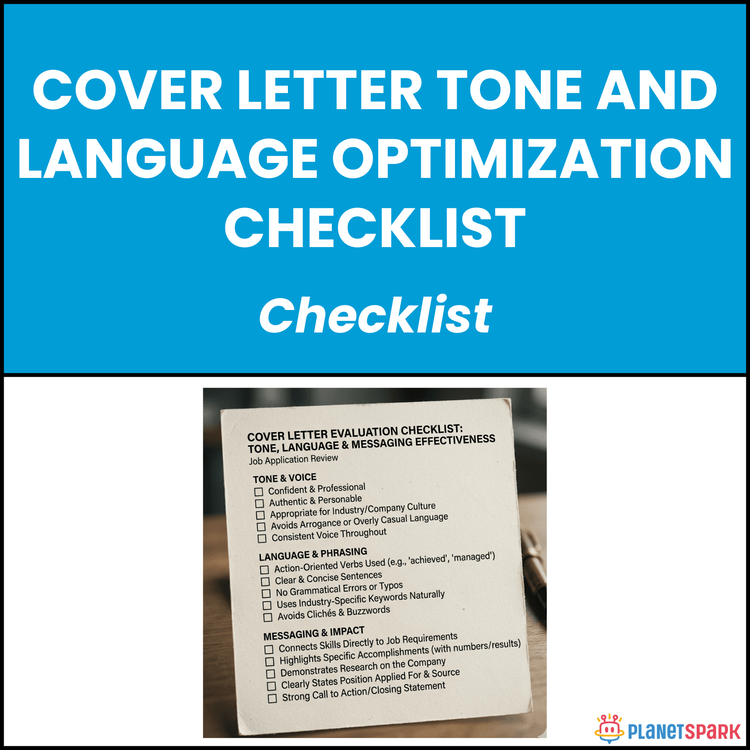
That’s exactly why the Cover Letter Tone and Language Optimization Checklist was created. This resource helps working professionals systematically refine their cover letter language so it sounds confident, relevant, and tailored to the organization they are applying to.
Instead of guessing what “sounds professional,” this checklist gives you a practical process to audit and strengthen every part of your cover letter before you hit send.
Who Is This Resource For?
This checklist is designed specifically for working professionals who want their applications to stand out without sounding artificial or overly rehearsed.
You will benefit most from this resource if you are:
• Early to mid-career professionals (0–15 years of experience) applying for new roles
• Career switchers who need to communicate credibility in a new industry
• Consultants who want to avoid sounding overly transactional in applications
• Managers and team leads who want to communicate authority without excessive jargon
• Job seekers who are receiving few responses and suspect their cover letter may be part of the problem
• Professionals who want a repeatable system to improve every cover letter they write
Whether you are applying to a traditional corporation, a fast-growing startup, or a mission-driven organization, the language you use must align with the expectations of that environment. This resource helps you do exactly that.
What Does This Resource Contain?
The Cover Letter Tone and Language Optimization Checklist is a structured, step-by-step guide that walks you through improving the tone, clarity, and impact of your cover letter.
Inside the resource, you will find:
Tone Calibration Framework
Before writing a single word, the checklist guides you through identifying the tone that best fits the organization. It introduces a tone spectrum ranging from formal-traditional environments to conversational and dynamic startup cultures.
You will answer targeted questions about the company, its communication style, and the likely reader of your application.
Word-Level Language Audits
The resource includes practical audits that help you improve the impact of your language by:
• Eliminating overused phrases and clichés
• Replacing weak verbs with stronger, action-oriented alternatives
• Removing hedge language that weakens confidence
These small changes dramatically strengthen the overall impression of your writing.
Sentence Structure and Rhythm Guidelines
Many cover letters fail because they feel heavy, monotonous, or overly academic. The checklist introduces the “Three-Rhythm Principle,” which encourages you to structure paragraphs using:
• Short, authoritative statements
• Medium-length explanatory sentences
• Short pivot sentences that connect your experience to the company’s needs
This creates momentum and keeps the reader engaged.
Cultural Register Alignment
Different industries and organizations expect different communication styles. The resource shows how to adjust your language depending on whether you are applying to:
• Formal institutional organizations
• Startups and scale-ups
• Mission-driven or nonprofit environments
Learning how to match cultural register is one of the most powerful signals of professional awareness.
Opening and Closing Paragraph Checklists
The opening and closing paragraphs of a cover letter carry the most weight. This resource includes detailed checklists to help you:
• Avoid weak openings like “I am writing to apply for…”
• Establish your professional identity quickly
• End with a confident call to action rather than a passive close
Real Before-and-After Examples
To make the advice practical, the guide includes real transformations showing how weak cover letter language can be rewritten to sound stronger, more confident, and more specific.
Master Pre-Submission Checklist
Before sending your application, you can run through a comprehensive audit covering tone, word choice, sentence structure, and opening/closing effectiveness.
Self-Evaluation and Improvement Framework
The resource also includes a scoring sheet that allows you to rate your cover letter across key dimensions such as tone calibration, word-level strength, sentence architecture, opening impact, and closing confidence.
Summary of the Resource
At its core, the Cover Letter Tone and Language Optimization Checklist is a practical editing system for professionals who want their cover letters to sound clear, confident, and relevant.
Instead of relying on generic templates, this resource helps you:
• Align your tone with the organization’s culture
• Replace weak language with strong, evidence-based statements
• Structure your writing in a way that keeps readers engaged
• Open and close your letter with authority and clarity
• Create a repeatable process you can use for every application
In about 25 minutes, you can learn the framework. In 15 minutes, you can audit an existing cover letter. And in under five minutes, you can run the final pre-submission check.
How Will This Resource Be Useful?
This checklist delivers several real-world benefits for professionals navigating the job market.
Improves First Impressions
Hiring managers often decide within seconds whether an application feels compelling. A well-calibrated tone and confident language dramatically improve that first impression.
Eliminates Generic Cover Letters
Many cover letters sound identical because they rely on the same clichés and template language. This checklist helps you replace generic claims with concrete, specific statements.
Strengthens Professional Credibility
Removing hedge language and weak phrasing makes your communication sound more decisive and capable — two qualities employers look for immediately.
Makes Your Applications More Targeted
By calibrating tone and cultural register, you demonstrate that you understand the organization and have tailored your message accordingly.
Creates a Repeatable Writing System
Instead of starting from scratch each time, you gain a structured process that makes writing future cover letters faster and more effective.
How Should You Use This Resource?
This checklist is designed to support professionals at different stages of the job application process.
First-Time Learning
If you are new to optimizing cover letter language, start by reading through the entire resource from beginning to end. This will help you understand the principles behind tone, structure, and word choice.
Active Drafting
When writing or revising a cover letter, use the individual checklists as a live editing tool. Review your tone, scan for weak verbs, and adjust your sentence rhythm while drafting.
Pre-Submission Review
Before submitting your application, use the master checklist to ensure every part of your letter meets a high standard. This final pass can often catch small mistakes that significantly weaken your message.
Over time, the process becomes faster because the principles become second nature.
Action Steps
If you want to immediately improve the quality of your cover letters, start with these simple steps:
1. Identify the cultural tone of the organization you are applying to before drafting your letter.
2. Write your first draft without worrying about perfection.
3. Run the word-level audits to eliminate clichés and weak verbs.
4. Adjust sentence rhythm using the Three-Rhythm Principle.
5. Rewrite your opening paragraph so it immediately establishes your professional value.
6. Strengthen your closing paragraph with a confident call to action.
7. Run the master checklist before submitting your application.
Following these steps consistently can transform how your applications are received.
Strong professional communication is not just a job search skill — it is a career skill. The way you express your achievements, ideas, and ambitions shapes how others perceive your capability and credibility.
Treating language as a craft rather than an afterthought allows you to present your experience with clarity and confidence. The more systematically you refine your communication, the more compelling your professional story becomes.
This checklist gives you a practical framework to do exactly that — one cover letter at a time.