
Evolving From Reactive Communication to Strategic Communication Mastery

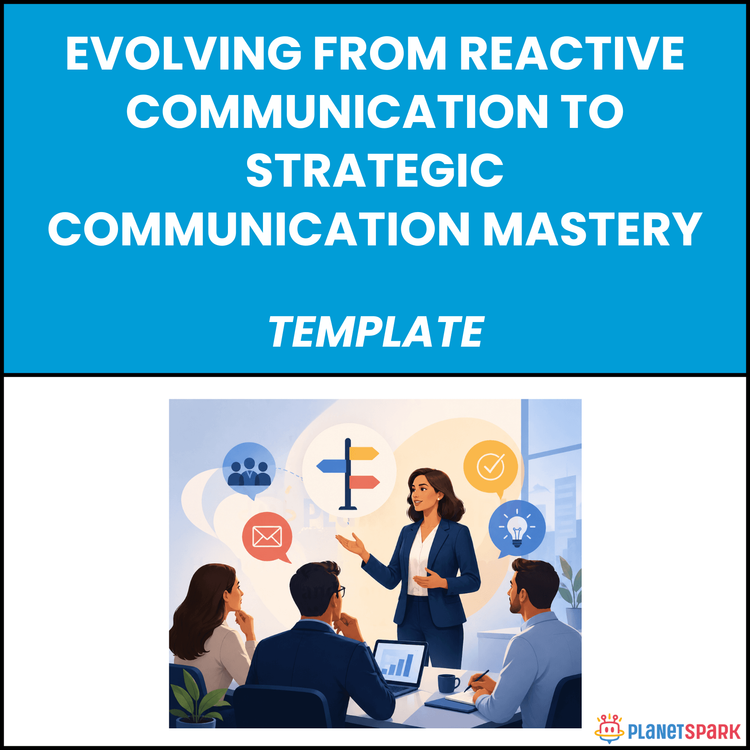
Evolving From Reactive Communication to Strategic Communication Mastery
Reactive Communication to Strategic Communication Mastery: A Practical Playbook for Working Professionals
Why Strategic Communication Is the Career Skill You Can't Afford to Ignore
Most professionals are never formally taught how to communicate strategically. They learn on the job — often through costly mistakes, missed opportunities, or feedback that arrives too late. The result? A default mode of reactive communication: responding to whatever lands in front of you, without a clear intention, audience awareness, or desired outcome in mind.
Reactive communication isn't a character flaw — it's a habit formed under pressure. But in today's workplace, where influence, visibility, and trust are built through every interaction, reactive habits quietly cap your career ceiling. The professional who can walk into any room — a board meeting, a difficult conversation, a job interview, a client pitch — and communicate with clarity, calm, and strategic intent is the one who gets remembered, promoted, and trusted.
"Strategic communication is not about saying more. It's about saying the right thing, to the right person, at the right moment — with a clear outcome in mind."
This playbook solves a specific problem: the gap between knowing communication matters and actually having a system to do it well. It is designed to be skimmed for quick reference or read deeply for full application. Each section builds on the last, but you can also jump to the module most relevant to your current challenge. Use it before a big presentation, during a career transition, or as a regular self-coaching tool.
The Communication Effectiveness Tracker is designed to solve exactly this problem. It gives you a structured, repeatable system to evaluate how you communicate, identify blind spots, and improve with intention—every single week.
Who Is This Resource For?
This tracker is built for professionals who want to become more effective, visible, and impactful in their roles. It is especially useful for:
- Early to mid-career professionals (0–15 years of experience)
- Managers and team leads handling cross-functional communication
- Consultants and client-facing professionals
- Job seekers preparing for interviews and networking conversations
- Career switchers who want to build confidence in new environments
- Anyone who feels “I know what I want to say, but I struggle to express it clearly”
If your growth depends on how well you communicate—this resource is for you.
What Does This Resource Contain?
The Communication Effectiveness Tracker is not just a worksheet—it’s a complete system built across multiple modules:
- The 5 Dimensions of Communication Effectiveness
A clear framework covering Clarity, Empathy, Conciseness, Influence, and Adaptability—so you know exactly what to track and improve.
- Self-Audit & Awareness Tools
A structured baseline assessment with reflection prompts to help you understand your current communication patterns and blind spots.
- Weekly Communication Log
A practical tracking template where you log real communication moments, rate your performance, and build a data-driven view of your habits.
- Real-World Communication Techniques
Actionable tools like:
- BLUF (Bottom Line Up Front)
- Mirror & Match technique
- 3-Question Close
- Intentional Pause
These are immediately applicable in meetings, emails, and presentations.
- Monthly Review & Pattern Recognition System
A checklist and sprint goal template to analyze your communication data and set focused improvement goals.
- 30-Day Kickstart Plan
A step-by-step roadmap to help you move from awareness to measurable improvement within a month.
- Real Case Study
A practical example of how a mid-level professional improved communication effectiveness and career visibility in just six weeks.
Summary of the Resource
At its core, the Communication Effectiveness Tracker helps you do three things:
- Measure how you communicate across five key dimensions
- Identify patterns and gaps using real-world data
- Improve systematically using proven techniques and structured reflection
Instead of guessing whether you’re improving, you get a clear, trackable path to better communication.
How Will This Resource Be Useful?
This resource delivers practical, real-world benefits that directly impact your career:
- Improved clarity in meetings and presentations
- Stronger influence in decision-making conversations
- Better control in high-pressure or difficult discussions
- Increased confidence in expressing ideas
- Faster recognition and visibility at work
- Reduced misunderstandings and back-and-forth communication
Most importantly, it closes the gap between how you think you communicate and how others actually experience you.
How Should You Use This Resource?
To get the most value, use this tracker as an ongoing system—not a one-time read:
Step 1: Start with the self-audit
Assess yourself honestly across the five communication dimensions using recent real examples.
Step 2: Begin weekly tracking
Log at least three communication moments per week. Focus on meaningful interactions like meetings, presentations, or difficult conversations.
Step 3: Apply one technique at a time
Use tools like BLUF or the Intentional Pause in real situations and track their impact.
Step 4: Reflect monthly
After 4–6 weeks, review your logs to identify patterns—where you consistently perform well and where you struggle.
Step 5: Set a 30-day improvement goal
Use the sprint goal template to focus on one dimension and one context at a time.
Step 6: Repeat and refine
Revisit the tracker regularly. Communication improvement compounds over time with consistency.
Action Steps
If you’re ready to improve your communication, start here:
1. Complete your baseline self-assessment today
2. Identify one recent communication win and one challenge
3. Start logging at least three interactions this week
4. Choose one technique (e.g., BLUF) to apply immediately
5. Schedule a monthly review date in your calendar
6. Ask one trusted colleague for honest feedback
Small, consistent actions will create measurable improvements within weeks.
Communication is not a talent you either have or don’t have—it’s a skill you build through awareness, practice, and reflection. The professionals who grow fastest are not necessarily the smartest—they are the most intentional about how they communicate.
If you commit to tracking your communication, applying the techniques, and reviewing your progress regularly, you will see a clear shift—not just in how you speak, but in how others respond to you.