
How to Build a Team Execution System That Delivers Consistently

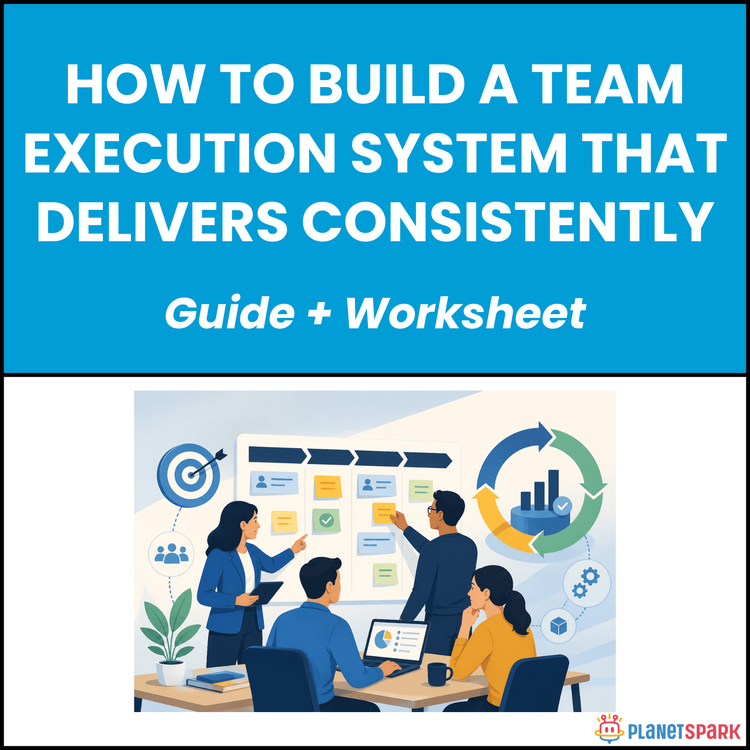
How to Build a Team Execution System That Delivers Consistently
Build a Team Execution System That Delivers Consistently (Without Burning Out Your Team)
Most teams don’t fail because they lack talent. They fail because they lack structure.
Deadlines slip. Priorities keep changing. Meetings feel reactive instead of productive. And despite everyone being busy, progress feels inconsistent.
If that sounds familiar, you’re not dealing with a performance problem—you’re dealing with an execution system problem.
The “How to Build a Team Execution System That Delivers Consistently” template pack was created to solve exactly this. It gives you a structured, repeatable way to plan, assign, track, and review work—so your team can deliver reliably, not occasionally.
Who Is This Resource For?
This resource is designed for professionals responsible for driving team outcomes, including:
- First-time managers building structure for their team
- Team leads struggling with inconsistent delivery
- Consultants designing execution systems for clients
- Senior leaders scaling team output without increasing oversight
- Project managers managing multiple workstreams
- Cross-functional teams dealing with unclear ownership and communication gaps
If your team is busy but not consistently productive, this resource is for you.
What Does This Resource Contain?
This is a complete execution toolkit—not just theory.
Inside, you’ll find 10 practical, scenario-based templates that cover every stage of team execution:
1. Team Execution Charter
Defines team purpose, goals, and working agreements
2. Weekly Execution Rhythm Planner
Structures your weekly cadence for planning, tracking, and review
3. Decision Log & Ownership Tracker
Ensures decisions are documented and followed through
4. Task Ownership & Accountability Matrix
Assigns clear ownership to every task (no ambiguity)
5. Sprint Goal & Commitment Canvas
Aligns the team on what’s being delivered in each cycle
6. Team Health & Blockers Check-In
Surfaces hidden blockers and team capacity issues
7. Stakeholder Communication Cadence Planner
Creates predictable updates for stakeholders
8. Quarterly Execution Review Template
Evaluates performance and sets direction for the next cycle
9. Delivery Retrospective Worksheet
Converts lessons into actionable improvements
10. New Member Execution Onboarding Guide
Helps new hires integrate quickly into your system
Each template is tied to a real-world execution problem—so you’re not guessing what to fix or how to fix it.
Summary of the Resource
This template pack helps you build a structured execution system that transforms your team from reactive and inconsistent to predictable and high-performing.
Instead of relying on effort and follow-ups, you’ll create a system where:
- Work is clearly owned
- Progress is visible
- Decisions are tracked
- Feedback loops drive improvement
How Will This Resource Be Useful?
This resource directly improves how your team operates day-to-day.
Here’s what you’ll gain:
- Clarity: Everyone knows what they own and what success looks like
- Accountability: No more “I thought someone else was handling it”
- Consistency: Work gets delivered every cycle—not just when things go well
- Visibility: Stakeholders stay informed without chasing updates
- Efficiency: Less time wasted on status updates and rework
- Scalability: Systems replace dependency on individual effort
The resource also highlights key performance benchmarks—for example, high-performing teams complete 85%+ of committed sprint tasks and respond to blockers within 24 hours.
How Should You Use This Resource?
Don’t try to implement everything at once. This resource works best when applied step-by-step.
Here’s the recommended approach:
Phase 1: Build the Foundation (Days 1–5)
Start with:
- Team Execution Charter
- Task Ownership Matrix
Define how your team works and who owns what.
Phase 2: Establish Rhythm (Days 6–14)
Introduce:
- Weekly Execution Planner
- Decision Log
Create a predictable cadence for planning and tracking.
Phase 3: Improve Visibility (Days 15–21)
Add:
- Stakeholder Communication Planner
- Sprint Goal Canvas
Ensure alignment internally and externally.
Phase 4: Build Feedback Loops (Days 22–30)
Use:
- Team Health Check-In
- Delivery Retrospective
Start improving your system continuously.
This phased rollout ensures adoption without overwhelming your team.
Action Steps
If you want to start improving your team’s execution immediately, follow this:
1. Run a team session to create your Team Execution Charter
2. Map all current tasks into a Task Ownership Matrix
3. Introduce a weekly planning rhythm using the planner template
4. Start documenting every key decision in a shared log
5. Identify and communicate your top 3 weekly outcomes
6. Run your first retrospective after 2–3 weeks
7. Adjust your system based on what’s actually working
Execution doesn’t improve by trying harder—it improves by building better systems.
Most teams operate on effort. High-performing teams operate on structure.
When you implement a clear execution system, you remove confusion, reduce dependency on constant follow-ups, and create a team that delivers consistently—regardless of pressure or complexity.
Start with one template. Build momentum. Then scale.
That’s how execution becomes a system—not a struggle.