
How To Communicate Disagreement Without Damaging Relationships

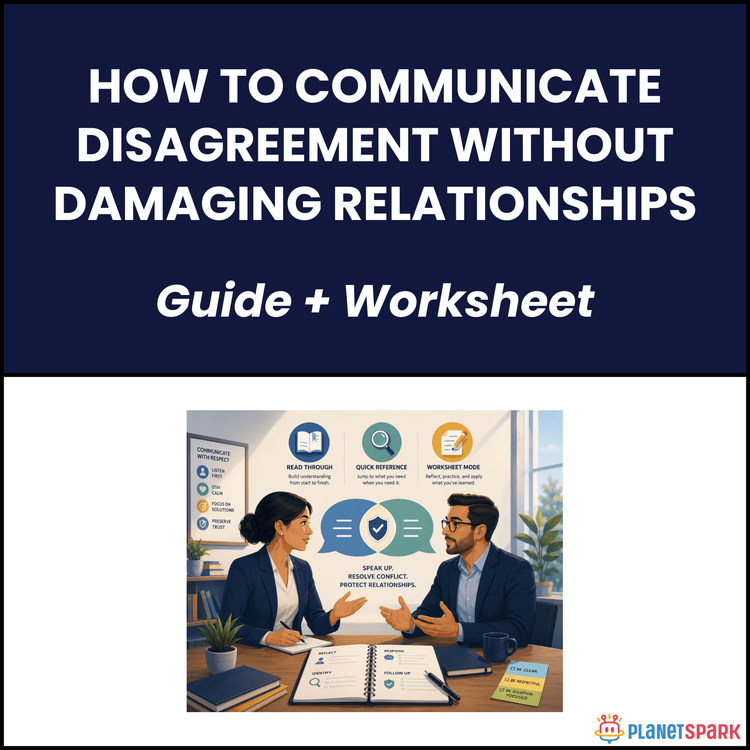
How To Communicate Disagreement Without Damaging Relationships
Mastering Difficult Conversations at Work
Most professionals don’t struggle with communication because they lack intelligence or expertise. They struggle because disagreement feels risky.
You may hesitate to speak up in meetings, avoid giving honest feedback, stay silent when decisions seem flawed, or replay difficult conversations in your head long after they end. On the other hand, speaking too directly can sometimes create tension, defensiveness, or long-term damage to important professional relationships.
The reality is that disagreement is unavoidable in any serious career. Whether you are collaborating with teammates, managing clients, leading projects, or working with senior leadership, your ability to communicate disagreement constructively becomes one of the most important professional skills you can develop.
That is exactly where this resource becomes valuable. This guide is designed to help working professionals communicate difficult opinions with clarity, confidence, and emotional intelligence—without creating unnecessary conflict or damaging trust. Instead of generic communication advice, it provides practical frameworks, workplace scripts, preparation tools, and reflection exercises that can be applied immediately in real professional situations.
Who Is This Resource For?
This resource is especially useful for:
- Working professionals with 0–15 years of experience
- Managers and team leads handling difficult conversations regularly
- Professionals who avoid conflict and struggle to speak up
- Individuals who feel they become too emotional or reactive during disagreements
- Consultants and client-facing professionals navigating sensitive discussions
- Career switchers building stronger workplace communication skills
- Professionals working in collaborative or cross-functional teams
- Anyone who wants to communicate more confidently while protecting relationships
If you have ever thought:
- “I should have said something in that meeting.”
- “I don’t know how to disagree without sounding rude.”
- “I avoid difficult conversations until they become bigger problems.”
- “I struggle to stay calm when challenged.”
Then this guide is built specifically for you.
What Does This Resource Contain?
This is not a theoretical communication handbook. It is a practical workplace resource designed for immediate application.
Inside the guide, you’ll find:
- A complete breakdown of why professionals struggle with disagreement
- The CLEAR Framework for navigating difficult conversations with structure and confidence
- Step-by-step guidance for preparing before important conversations
- Communication phrases that open conversations instead of escalating tension
- Practical methods for managing pushback and resistance professionally
- Post-conversation follow-up strategies to preserve relationships
- Context-specific frameworks for disagreeing with:
- Managers
- Peers
- Direct reports
- Clients
- Real-world workplace case studies and conversation examples
- Common communication mistakes professionals make during disagreements
- Worksheets to help you prepare before difficult conversations
- Self-assessment exercises to evaluate your current communication style
- Emotional regulation strategies for high-pressure conversations
- Cross-cultural communication guidance for global workplaces
- Ready-to-use scripts for high-stakes professional scenarios
- A quick-reference disagreement toolkit
- A structured 30-day practice plan to build long-term communication confidence
Everything is designed to help professionals move from emotional reactions to thoughtful, solution-focused communication.
Summary of the Resource
This resource helps professionals learn how to disagree clearly, respectfully, and effectively in workplace situations where relationships and outcomes both matter.
Instead of teaching conflict avoidance or aggressive communication, the guide focuses on skilled assertion—helping readers express concerns, challenge ideas, and navigate tension while maintaining professionalism and trust.
Through frameworks, scripts, worksheets, and real-world examples, the guide turns difficult conversations into structured, manageable interactions that lead to better collaboration and stronger professional credibility.
For busy professionals, it offers a practical system that can be applied immediately in meetings, feedback conversations, project discussions, and client interactions.
How Will This Resource Be Useful?
Strong disagreement communication impacts nearly every part of professional growth.
This resource helps you:
- Speak up with greater confidence during important discussions
- Reduce anxiety around difficult conversations
- Communicate concerns without sounding aggressive or emotional
- Improve workplace relationships through respectful honesty
- Handle pushback without becoming defensive
- Build stronger trust with managers, peers, and clients
- Make conversations more solution-oriented instead of emotionally charged
- Increase professional credibility and influence
- Develop leadership-level communication skills
- Create healthier collaboration within teams
One of the strongest aspects of this guide is that it focuses not only on what to say, but also:
- When to say it
- How to say it
- How to prepare mentally
- How to manage emotions during pressure
- How to repair and strengthen relationships afterward
These are the communication skills that often separate professionals who stay stuck from those who grow into leadership roles.
How Should You Use This Resource?
To get the maximum value from this guide, approach it as a working communication toolkit rather than a one-time read.
Start by reading through the full guide once to understand the overall philosophy and frameworks behind healthy disagreement communication.
Then move into practical application.
Begin with the CLEAR Framework and use it during smaller, low-stakes conversations first. This helps build familiarity before applying it in higher-pressure situations.
Next, complete the preparation worksheets before any meaningful disagreement conversation. Writing out your thoughts beforehand improves clarity and reduces emotional reactivity significantly.
As you progress, practice:
- The suggested opening lines
- The pushback management techniques
- The emotional regulation strategies
- The post-conversation reflection exercises
The guide is especially powerful when revisited repeatedly over time.
You can return to it whenever you:
- Prepare for a difficult meeting
- Need to challenge a decision respectfully
- Navigate team conflict
- Give upward feedback
- Handle client disagreements
- Manage emotionally charged conversations
- Improve leadership communication skills
The more intentionally you practice these frameworks, the more natural they become in real-world situations.
Action Steps
After accessing this resource, take these steps immediately:
1. Identify one disagreement conversation you have been avoiding
2. Read the CLEAR Framework carefully and understand each component
3. Complete the pre-conversation worksheet before your next difficult discussion
4. Write down your opening sentence in advance
5. Practice replacing reactive phrases with solution-focused language
6. Use the post-conversation reflection prompts after important discussions
7. Follow the 30-day communication practice plan included in the guide
Small improvements in difficult conversations create long-term improvements in trust, influence, leadership presence, and professional relationships.
The professionals who grow the fastest are not the ones who avoid disagreement. They are the ones who learn how to handle it with clarity, emotional intelligence, and professionalism.
This resource helps you build exactly that capability. When you learn how to disagree without damaging relationships, you become someone people trust in high-pressure situations. You communicate with greater confidence, contribute more meaningfully to important decisions, and create stronger professional relationships over time.
Use this guide not only to improve conversations, but to strengthen how you lead, collaborate, and show up professionally every day.