
How To Handle Interruptions And Maintain Communication Control

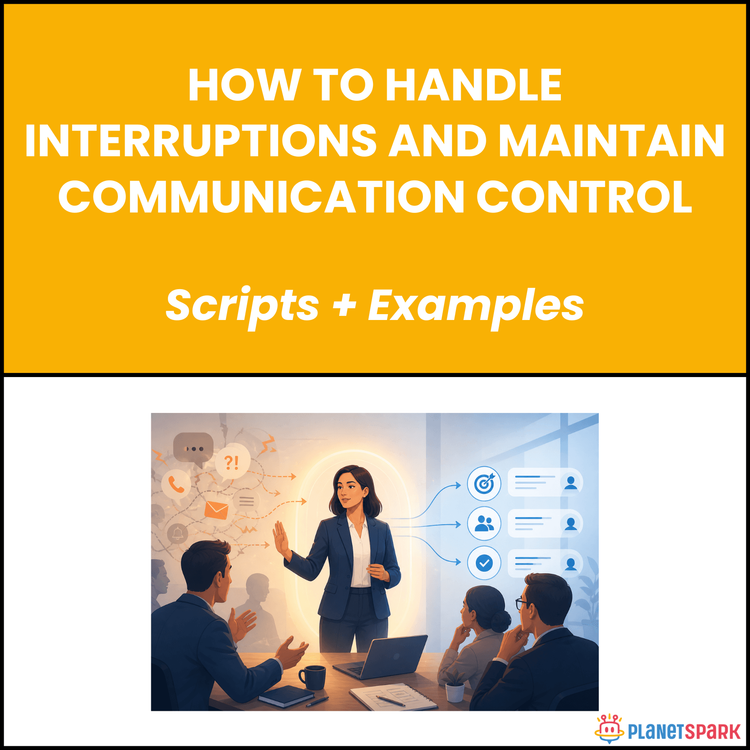
How To Handle Interruptions And Maintain Communication Control
Mastering Conversations at Work
Interruptions are one of the most frustrating—and underestimated—challenges in professional communication. You prepare your point, you begin speaking, and suddenly someone cuts in. In that moment, most professionals either go silent, react defensively, or lose track of what they were saying altogether.
The real problem isn’t the interruption itself. It’s not knowing how to respond in a way that keeps your authority intact while preserving the relationship.
This is exactly where the resource on handling interruptions and maintaining communication control becomes powerful. It gives you clear, practical scripts and frameworks to stay composed, hold your ground, and guide conversations with confidence—even in high-stakes situations.
Who Is This Resource For?
This resource is designed for professionals who want to be heard, respected, and taken seriously in conversations.
It is especially useful for:
- Early to mid-career professionals (0–15 years of experience)
- Job seekers preparing for interviews and group discussions
- Managers and team leads running meetings or presentations
- Consultants and client-facing professionals handling discussions
- Individuals who feel they are often talked over or interrupted
- Professionals who want to communicate assertively without sounding aggressive
If you’ve ever felt like your ideas don’t land the way they should—this resource is built for you.
What Does This Resource Contain?
This is not a theoretical guide. It is a structured, real-world playbook filled with actionable communication tools.
Inside the resource, you will find:
- A clear breakdown of different types of interruptions (cooperative, intrusive, accidental)
- A framework to identify your default response style (yielder, fighter, freezer)
- Practical verbal scripts to hold the floor during conversations
- Non-verbal communication techniques (eye contact, gestures, posture)
- Ready-to-use phrases for redirecting conversations after interruptions
- A personalised worksheet to build your own response scripts
- Strategies to handle repeated interruptions and power dynamics
- Real-world case studies across meetings, presentations, and client calls
- Common communication mistakes and how to fix them instantly
- A self-evaluation audit to track and improve your communication skills over time
Each section is designed for immediate application—not just understanding.
Summary of the Resource
This resource is a complete communication control toolkit that helps professionals handle interruptions without losing clarity, confidence, or composure.
It moves beyond theory and gives you exact words to say, situations to practice, and frameworks to apply—so you can manage conversations effectively in real time.
Whether you’re in a team meeting, client discussion, or interview, it equips you to stay in control of your message.
How Will This Resource Be Useful?
This resource delivers practical outcomes that directly impact your professional presence.
You will:
- Speak with greater confidence in meetings and discussions
- Stop losing your turn when interrupted
- Maintain composure even in high-pressure conversations
- Communicate assertively without damaging relationships
- Improve how others perceive your authority and clarity
- Lead conversations instead of reacting to them
Most importantly, it helps you shift from reacting emotionally to responding strategically.
How Should You Use This Resource?
To get the most value, use this resource in a structured and consistent way.
Start by reading the full guide once to understand the overall framework of communication control.
Next, identify your current pattern:
Are you someone who yields, fights, or freezes when interrupted?
Then, begin practicing:
- Pick 2–3 scripts from the guide and rehearse them aloud
- Use them in low-stakes conversations first
- Gradually apply them in meetings, calls, or presentations
Work through the worksheets provided, especially the redirection script bank, to personalize responses for your own work scenarios.
Finally, use the self-evaluation audit regularly (as suggested in the resource) to track improvement and refine your communication approach over time.
Action Steps
If you want to start seeing results immediately, follow these steps:
1. Reflect on your last interruption experience—what did you do?
2. Identify your default response style (yield, fight, or freeze)
3. Choose one “floor-holding” script and practice it today
4. Use that script in your next meeting or conversation
5. Write down one situation where you lost control—and how you will handle it next time
6. Repeat this process consistently for the next 7 days
Small, consistent practice builds lasting communication confidence.
Strong communication is not about speaking more—it’s about speaking with clarity, intention, and control. When you learn how to handle interruptions effectively, you don’t just improve conversations—you strengthen your professional presence.
Over time, this skill compounds. You get heard more. Your ideas carry weight. Your confidence becomes visible.
And that changes how people respond to you in every room you walk into.