
How to Transition From Skill-Based to Moat-Based Career Strategy

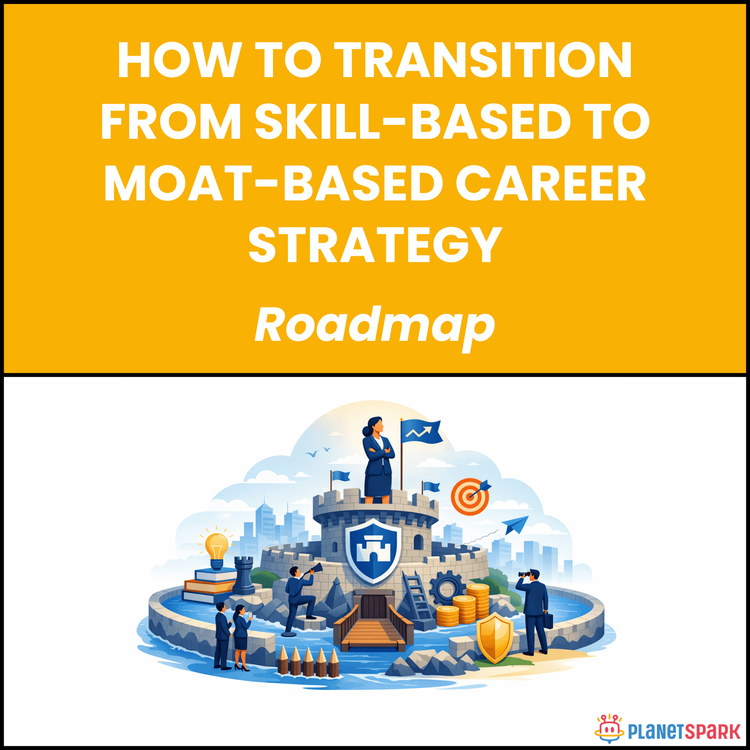
How to Transition From Skill-Based to Moat-Based Career Strategy
Moving Beyond Skills to a Moat-Driven Career Strategy: A Practical Guide for Building Lasting Career Advantage
If you’ve ever felt like you’re doing everything right—learning new skills, delivering strong results, staying consistent—but still not seeing the growth, recognition, or opportunities you expected, you’re not alone.
Most professionals build their careers around skills. They collect certifications, gain experience, and improve performance. But in today’s competitive landscape, skills alone are no longer enough to create lasting career success.
The real differentiator is something deeper: a career moat.
That’s exactly why the resource “How to Transition from a Skill-Based to a Moat-Based Career Strategy” exists. It helps you move beyond just being skilled—to becoming truly irreplaceable.
This guide gives you a structured system to build a career that is not only valuable today, but increasingly difficult to compete with over time.
Who Is This Resource For?
This resource is especially valuable if you are:
- A working professional with 0–15 years of experience
- A job seeker struggling to stand out despite strong skills
- A career switcher trying to build a compelling narrative
- A consultant or specialist aiming to become highly in-demand
- A mid-career professional feeling stuck or undervalued
- Someone who wants long-term career security, not just short-term growth
If you feel like you’re competing on the same factors as everyone else, this resource will help you change that.
What Does This Resource Contain?
This is not a generic career advice guide. It’s a structured, phase-by-phase system designed to help you build a sustainable competitive advantage.
Inside the resource, you’ll find:
- A clear explanation of the difference between skill-based and moat-based careers
- A complete framework built around four core pillars of differentiation:
- Proprietary Knowledge (your unique frameworks and insights)
- Trust Capital (strong, reliable professional relationships)
- Professional Reputation (what people say about you when you’re not in the room)
- Distinctive Point of View (your unique perspective on your domain)
- Practical guidance on how to build each pillar step-by-step
- A Career Asset Inventory to uncover hidden strengths and underutilised advantages
- A structured audit system to evaluate your current positioning and potential
- A 90-day moat-building plan broken into:
- Foundation (clarity and positioning)
- Activation (making your knowledge visible)
- Amplification (building relationships and reputation)
- A Moat Statement Framework to clearly communicate your value:
- Who you help
- What problem you solve
- How you solve it differently
- What results you create
- A real-world case study showing how a professional moved from being a generalist to a highly specific, in-demand expert
- Common mistakes professionals make when trying to build their brand—and how to fix them
- A quarterly maintenance system to sustain and compound your career advantage over time
Everything is designed to be applied immediately, not just understood.
Summary of the Resource
“How to Transition from a Skill-Based to a Moat-Based Career Strategy” is a practical, structured guide that helps you move from being replaceable to becoming strategically indispensable.
It shows you how to build a career advantage that compounds—by combining your knowledge, relationships, reputation, and perspective into a system that is uniquely yours.
How Will This Resource Be Useful?
This resource helps you move from competition to differentiation.
You’ll gain:
- A clear understanding of why skills alone are not enough
- A structured system to build long-term career advantage
- The ability to identify and leverage your hidden career assets
- Strong positioning that makes you easier to recognise and remember
- Increased visibility and credibility in your professional space
- A network that actively supports and advocates for you
- A repeatable system for continuous career growth
Most importantly, it helps you stop competing as “one of many”—and start positioning yourself as “the obvious choice.”
How Should You Use This Resource?
To get the best results, follow a phased approach:
Start by reading the full guide once to understand the overall framework and how each phase connects.
Next, complete the Career Asset Inventory. Identify your existing strengths, experiences, and relationships without underestimating them.
Then, define your moat:
- Clarify your distinctive point of view
- Identify your strongest pillars
- Draft your initial positioning statement
Once you have clarity, move into action:
- Follow the 90-day plan:
- First 30 days: build clarity and update your positioning
- Next 30 days: make your knowledge visible (write, share, contribute)
- Final 30 days: deepen relationships and expand visibility
After that, focus on communication:
- Refine your moat statement
- Test it in conversations
- Update your LinkedIn and resume
Finally, build consistency:
- Capture new insights regularly
- Share your thinking periodically
- Invest in relationships weekly
Revisit the framework every quarter to ensure you’re progressing and not drifting back to a purely skill-based approach.
Action Steps
After accessing this resource, take these steps immediately:
1. Block 2 hours this week for a deep career audit
2. Complete the Career Asset Inventory honestly
3. Identify one high-potential asset that is currently invisible
4. Draft your first Moat Statement (who you help, problem, approach, outcome)
5. Share one insight or experience publicly or internally
6. Reach out to 2–3 people to strengthen meaningful professional relationships
7. Commit to one consistent weekly action (writing, networking, or documenting insights)
Small, focused actions here will start building long-term career leverage.
Most professionals keep adding skills—but never build a system that makes those skills uniquely valuable. A moat-based career is not about doing more. It’s about being more deliberate with what you already have.
When you combine your insights, relationships, reputation, and perspective into a clear, visible system, you stop competing on effort—and start winning on differentiation.
Use this resource to build a career that becomes stronger, more visible, and more in-demand over time.