
Interview Stalling Phrases (When Unsure)

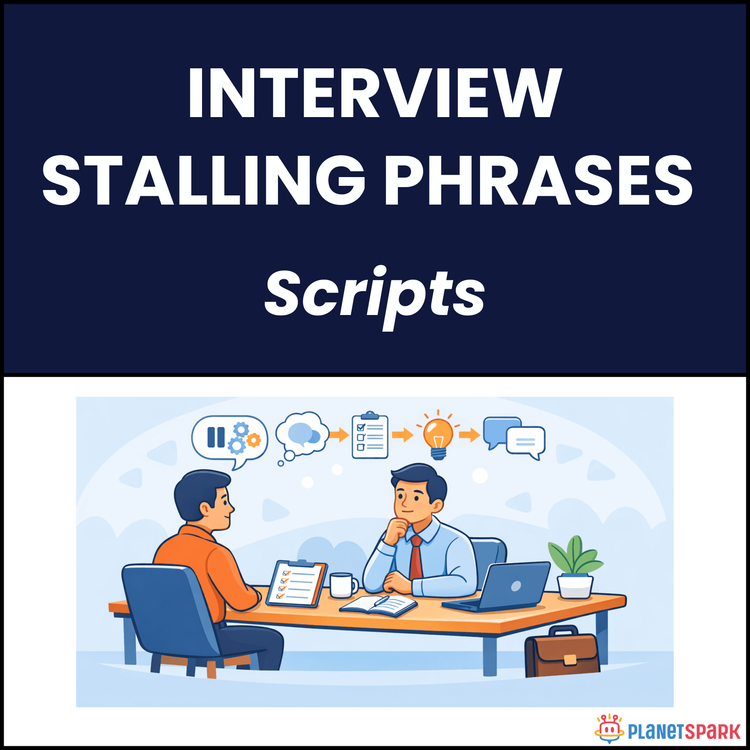
Interview Stalling Phrases (When Unsure)
Tough Interview Questions Guide: Strategic Stalling Phrases That Help You Answer Better
Most professionals have experienced the same uncomfortable moment in an interview. The interviewer asks a complex question, your mind suddenly goes blank, and you feel pressure to respond immediately. In that moment, many candidates rush into half-formed answers, apologise unnecessarily, or begin rambling without a clear structure.
But experienced interviewers are not just evaluating your knowledge. They are observing how you think, how you handle pressure, and whether you can communicate thoughtfully when faced with uncertainty.
This is where the concept of strategic stalling becomes powerful.
The Interview Stalling Phrases toolkit from PlanetSpark is designed to help professionals manage these moments with composure and clarity. Instead of panicking when a difficult question appears, this resource gives you professional phrases and structured techniques that allow you to pause, think, and deliver a more confident response.
When used correctly, a short pause does not signal weakness. It signals professionalism and thoughtful communication.
Who Is This Resource For?
This resource is especially valuable for professionals who regularly participate in high-stakes interviews or career transitions.
It is designed for:
• Job seekers preparing for competitive interviews
• Career switchers entering a new industry or role
• Early- to mid-career professionals building stronger interview presence
• Managers preparing for leadership or promotion interviews
• Consultants and professionals navigating senior-level conversations
Anyone who wants to appear more composed, structured, and confident in interviews can benefit from this resource.
What Does This Resource Contain?
The toolkit is structured as a practical script library combined with interview preparation exercises. Instead of abstract advice, it provides language you can actually use during interviews.
Inside the resource, you will find:
A structured framework for recognising when to pause
The guide explains how to identify situations where a strategic pause is helpful, such as multi-part behavioural questions, hypothetical scenarios, or unexpected personal questions.
A master library of professional stalling phrases
The toolkit organizes phrases into five categories so professionals can respond appropriately depending on the situation.
These include:
• Phrases for buying thinking time
• Phrases for clarifying the interviewer’s question
• Phrases for acknowledging complex topics
• Phrases for handling knowledge gaps gracefully
• Phrases for bridging toward your strongest experience
Transition phrases for structured answers
The resource also teaches how to move smoothly from a pause into a confident response using transition phrases that signal clarity and structure.
A practical interview readiness checklist
A preparation checklist helps professionals rehearse stalling phrases, practise pauses, and prepare anchor stories before an interview.
A reflection worksheet
The worksheet helps readers identify their personal vulnerability points in interviews, such as question types that typically throw them off.
A phrase-pairing template
This template helps professionals build their own personalised script card combining stalling phrases, transitions, and real professional stories.
A real-world case study
The guide includes a scenario showing how a candidate used a brief pause and a structured phrase to transform a blank moment into a strong answer during a leadership interview.
Common mistakes and fixes
The resource also highlights common interview mistakes such as over-apologising, thinking out loud, bluffing knowledge, or overusing stalling phrases.
Summary of the Resource
At its core, this resource teaches professionals a simple but powerful rhythm for answering difficult interview questions:
Pause → Phrase → Answer
Instead of rushing into responses, professionals learn to briefly pause, use a professional phrase that signals thoughtful processing, and then transition into a structured answer.
The toolkit combines ready-to-use language, preparation exercises, and reflection tools so that these techniques become natural during interviews.
How Will This Resource Be Useful?
The Interview Stalling Phrases toolkit offers several practical benefits for professionals preparing for interviews.
Improves interview composure
You learn how to manage difficult questions without appearing nervous or unprepared.
Gives you time to think strategically
A short, well-worded pause can give you 10–30 seconds to organise your thoughts before answering.
Helps structure stronger answers
Transition phrases help you move into responses that sound clear, organised, and professional.
Prevents common interview mistakes
The resource teaches you how to avoid rambling, apologising unnecessarily, or fabricating answers.
Builds communication confidence
With practice, these phrases become natural tools that improve how you handle high-pressure conversations.
Strengthens professional presence
Interviewers often associate calm pauses and structured answers with emotional intelligence and leadership potential.
How Should You Use This Resource?
To get the most value from this toolkit, approach it as both a learning guide and a practice resource.
Start by understanding when to use stalling phrases
Read the section explaining the types of questions that benefit from a pause. This helps you recognise when to deploy the technique.
Choose phrases that feel natural to you
Select two or three phrases from each category that match your communication style.
Practise the pause
Train yourself to pause for three seconds before answering complex questions. This small habit dramatically improves response quality.
Pair stalling phrases with transition phrases
For example, begin with a brief pause phrase and then move into a structured transition such as explaining your answer in two parts.
Prepare your anchor stories
Identify three professional stories that demonstrate leadership, problem-solving, or resilience. These stories help you bridge from stalling into a strong answer.
Rehearse out loud
Practise using these phrases during mock interviews so they feel natural during real conversations.
Action Steps
If you plan to use this resource for interview preparation, follow these simple steps.
1. Select two stalling phrases from each category that sound natural to your voice.
2. Identify three professional stories that you can adapt to multiple interview questions.
3. Complete the reflection worksheet to identify the interview questions that typically challenge you.
4. Use the phrase-pairing template to combine your stalling phrases with transition phrases.
5. Record a mock interview and practise using pauses and structured responses.
These steps help transform the toolkit from something you read into a skill you actually use during interviews.
Interviews rarely reward the person who answers the fastest. They reward the person who answers the most thoughtfully.
A short pause, a well-chosen phrase, and a structured response can transform a moment of uncertainty into a demonstration of professionalism and confidence.
The Interview Stalling Phrases toolkit helps you build that ability. With practice, the techniques become second nature, allowing you to remain composed even when unexpected questions arise.
Every interview contains moments where you need time to think. Learning how to handle those moments gracefully can significantly improve how interviewers perceive your communication skills, leadership potential, and decision-making ability.