
Job Search Metrics Tracker (Conversion Rate)

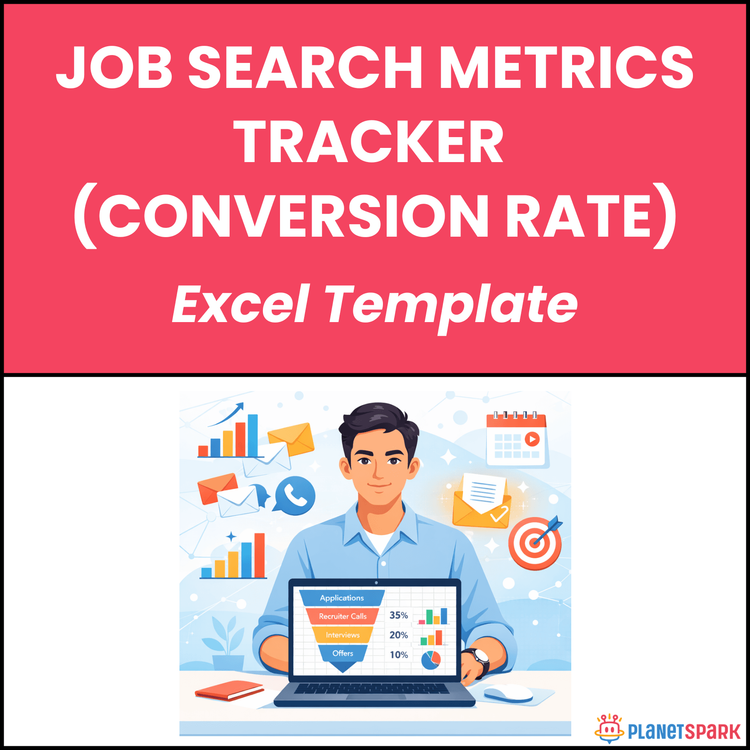
Job Search Metrics Tracker (Conversion Rate)
Job Search Metrics Tracker: How Data-Driven Professionals Turn Applications Into Offers
Most professionals approach job searching with effort, not strategy. They apply to dozens of roles, refresh their inbox repeatedly, and hope something eventually works out. When responses are slow or inconsistent, it is easy to assume the market is the problem.
But the real issue is often the absence of data.
Without tracking your job search activity, you cannot tell whether your CV is ineffective, your targeting is too broad, your interview performance needs improvement, or you are simply applying in the wrong places. Many job searches fail not because of lack of effort, but because professionals are operating without visibility into what is actually working.
The PlanetSpark Job Search Metrics Tracker was designed to solve this exact problem. It provides a practical Excel-based system that helps professionals measure their job search like a pipeline, track conversion rates at each stage, and identify exactly where improvements are needed. Instead of guessing, you begin making decisions based on real numbers.
According to the resource, the job search works much like a sales funnel, where applications lead to recruiter calls, interviews, and eventually offers. Tracking conversion between these stages reveals the precise bottlenecks slowing down your progress.
If you want to run a smarter, faster, and more strategic job search, this system shows you exactly how.
Who Is This Resource For?
This resource is designed for working professionals who want to bring clarity and structure to their job search process.
It is especially useful for:
- Job seekers actively applying to multiple roles
- Career switchers entering a new industry or function
- Early to mid-career professionals with 0–15 years of experience
- Consultants, managers, and specialists exploring new opportunities
- Professionals who want to make data-backed decisions instead of relying on guesswork
- Candidates who want to understand why their applications are not progressing
If you have ever wondered whether your CV, interview performance, or job targeting strategy is holding you back, this tracker helps you diagnose the real issue.
What Does This Resource Contain?
The Job Search Metrics Tracker is structured as a complete system rather than just a spreadsheet. It combines tracking tools, diagnostic frameworks, and reflection exercises that help professionals continuously improve their search strategy.
The resource includes:
A ready-to-use Excel tracker
A structured workbook with multiple sheets designed to capture job search data across applications, interviews, offers, and weekly progress.
Application Log
This acts as the master database of your job search. Every application is logged with key details such as company name, role title, source of application, CV version used, job function, company size, and current stage in the hiring process.
Conversion Dashboard
This sheet automatically calculates conversion rates between stages such as:
Applications → Recruiter Screen
Screen → First Round Interview
First Round → Final Round
Final Round → Offer
This dashboard gives you a clear visual overview of how your job search pipeline is performing.
Interview Log
A detailed record of every interview interaction including interviewer names, interview format, questions asked, your confidence rating, and reflections on what went well or needs improvement.
Offer Tracker
A structured sheet to compare offers objectively. It allows you to track salary packages, role level, benefits, location flexibility, and personal priority scores so that decisions are made rationally rather than emotionally.
Weekly Review Log
A simple weekly review system designed to keep your job search focused. It records weekly applications, stage movement, insights, and one key improvement goal for the coming week.
Reflection Worksheets
Strategic reflection questions that help you analyze patterns in your search, such as targeting strategy, interview performance, and referral usage.
Together, these tools create a complete system for managing and improving your job search.
Summary of the Resource
At its core, the Job Search Metrics Tracker transforms job searching from a reactive activity into a measurable process.
Instead of simply sending applications and waiting for responses, you begin tracking the performance of every stage of your search funnel.
The tracker helps you answer questions like:
- How many applications are actually converting into recruiter calls?
- Which job sources generate the best results?
- Which CV version performs better?
- Where in the interview pipeline are you getting stuck?
Within a few weeks of consistent tracking, most professionals can clearly identify where their job search strategy needs improvement.
This clarity dramatically accelerates progress.
How Will This Resource Be Useful?
The biggest advantage of this resource is that it replaces uncertainty with measurable insight.
When professionals do not track their search activity, they tend to focus on the wrong problems. For example, they may blame the job market when the real issue is poor CV targeting or weak interview preparation.
This tracker provides several powerful benefits:
Clarity in decision-making
You can see exactly where applications are dropping off in the hiring pipeline.
Improved CV and targeting strategy
By tracking which roles and sources produce interviews, you quickly identify the most effective approach.
Better interview preparation
Your interview log reveals patterns in performance, helping you improve specific weaknesses.
Objective offer evaluation
The offer tracker prevents emotional decision-making by comparing roles based on defined criteria.
Higher-quality job search strategy
Instead of increasing application volume blindly, you optimize your strategy based on real results.
Over time, this data-driven approach leads to faster interview pipelines and better career decisions.
How Should You Use This Resource?
To get the full benefit from the tracker, it should be used as a weekly system rather than a one-time setup.
Step 1: Read the guide once
Start by reading through the resource to understand how the job search funnel works and how each sheet contributes to the tracking system.
Step 2: Set up the Excel workbook
Create the five sheets outlined in the resource: Application Log, Conversion Dashboard, Interview Log, Offer Tracker, and Weekly Review.
Step 3: Start logging applications immediately
Every role you apply for should be logged in the Application Log with all relevant details.
Step 4: Track stage movement
Update the status of each application regularly as it progresses through recruiter calls and interviews.
Step 5: Record interview insights
After every interview, add your observations to the Interview Log while the details are still fresh.
Step 6: Run a weekly review
Set aside 10 minutes every week to review your dashboard, identify weak conversion points, and define one improvement for the following week.
Consistency is what turns this tracker from a spreadsheet into a powerful career strategy tool.
Action Steps
If you want to start applying this system immediately, follow these practical steps:
1. Create your job search workbook with the five tracking sheets.
2. Log all applications from the past two weeks to establish your baseline data.
3. Build your conversion dashboard using simple formulas.
4. Track every interview interaction and write quick reflections afterward.
5. Schedule a recurring 10-minute weekly review to analyze your data.
6. Identify one improvement goal each week based on your conversion numbers.
Within a few weeks, you will start seeing clear patterns that guide smarter decisions.
A successful job search is rarely about sending the most applications. It is about understanding your pipeline, identifying bottlenecks, and continuously improving your approach. Professionals who treat their search like a measurable system consistently move faster toward the right opportunities.
If you want to stop guessing and start optimizing your career strategy, the Job Search Metrics Tracker provides the structure to make that possible.