
Preparing Answers About Decision-Making Processes

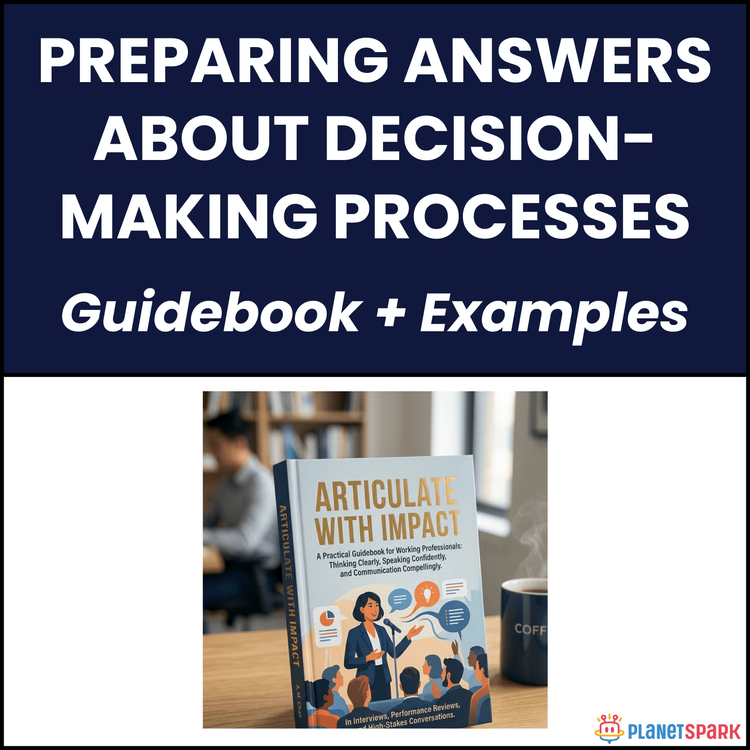
Preparing Answers About Decision-Making Processes
How to Answer Decision-Making Interview Questions
Many professionals walk into interviews or performance reviews confident about their experience — yet struggle when asked a simple question:
“Tell me how you make decisions.”Instead of communicating their real thinking process, they respond with vague statements such as “I evaluate the options” or “I trust my instincts.” While these responses may be honest, they fail to demonstrate the structured thinking, judgment, and accountability that employers are trying to assess.
Decision-making questions are not casual conversation. They are one of the most common ways hiring managers and leaders evaluate a professional’s ability to think critically, handle uncertainty, balance trade-offs, and take ownership of outcomes.
The resource “Preparing Answers About Decision-Making Processes” was created to help professionals solve this exact problem. It provides a clear framework for translating real work experiences into structured, compelling answers that demonstrate strong professional judgment.
If you have an interview, promotion conversation, or high-stakes meeting coming up, this guide gives you the tools to communicate your thinking with clarity and confidence.
Who Is This Resource For?
This resource is designed specifically for working professionals who want to communicate their decision-making skills more effectively in professional conversations.
You will benefit most from this guide if you are:
• Early-career professionals (0–3 years) preparing for interviews or internal reviews
• Mid-career professionals (4–10 years) managing teams, projects, or stakeholders
• Career switchers translating past experiences into a new role or industry
• Job seekers preparing for behavioural and situational interview questions
• Consultants, managers, and professionals who frequently need to explain their reasoning to stakeholders
• Anyone who feels they have strong experience but struggles to articulate it clearly under pressure
The guide is particularly valuable for time-poor professionals who want practical frameworks and actionable preparation techniques rather than theoretical career advice.
What Does This Resource Contain?
The guidebook is structured as a practical training resource that walks professionals step-by-step through the process of preparing strong decision-making answers.
Key components of the resource include:
Understanding What Interviewers Are Really Evaluating
The guide begins by explaining the real competencies behind decision-making questions, including:
• Information gathering
• Ambiguity tolerance
• Trade-off thinking
• Accountability and ownership
Understanding these evaluation criteria helps professionals structure answers that address what interviewers actually want to hear.
Summary of the Resource
At its core, this resource helps professionals do three important things:
First, it explains what interviewers are truly evaluating when they ask decision-making questions.
Second, it provides clear frameworks that help professionals organise their thinking and communicate their reasoning effectively.
Third, it offers practical tools — worksheets, templates, checklists, and examples — that make preparation faster and more structured.
By combining these elements, the guide transforms decision-making answers from vague explanations into compelling professional narratives.
How Will This Resource Be Useful?
The ability to explain how you make decisions is one of the most underrated career skills.
Professionals who communicate their reasoning clearly are more likely to:
• Build trust with hiring managers and stakeholders
• Demonstrate leadership potential during interviews
• Stand out during promotion and performance discussions
• Show structured thinking and accountability
• Navigate high-pressure conversations with confidence
Many capable professionals lose opportunities not because they lack experience, but because they struggle to communicate their thinking clearly under pressure.
This resource helps bridge that gap. Instead of improvising answers during interviews, you will have prepared stories, clear frameworks, and structured responses ready to use.
How Should You Use This Resource?
To get the most value from the guide, approach it in phases rather than trying to absorb everything at once.
Step 1: Read Through the Guide
Start by reading the guide end-to-end to understand the frameworks and concepts behind strong decision-making answers.
Step 2: Build Your Decision Story Inventory
Use the provided worksheet to document three real decision stories from your professional experience:
• One decision that went well
• One decision that was challenging
• One decision you would approach differently today
These three stories can cover the majority of decision-making questions you will encounter.
Step 3: Structure Your Stories Using STAR+
Once you have your raw stories documented, apply the STAR+ framework to shape them into structured responses.
Focus particularly on:
• The reasoning behind the decision
• The trade-offs you considered
• The learning that came from the outcome
Step 4: Practice Delivering Your Answers
Record yourself answering decision-making questions out loud. Listening to your own responses helps you identify:
• Whether your answer structure is clear
• Whether you are explaining your reasoning effectively
• Whether your answers stay within the ideal 2–3 minute range
Step 5: Use the Checklist to Refine
Before interviews or performance reviews, run your answers through the guide’s decision-making checklist to ensure they include:
• Clear structure
• Specific details
• Named trade-offs
• Genuine learning
This final review dramatically improves answer quality.
Action Steps
If you want to start applying this resource immediately, here are three practical actions you can take today:
1. Document Three Decision Stories
Spend 20 minutes writing down three real decisions from your professional experience.
2. Apply the STAR+ Structure
Transform those stories into structured answers using the Situation → Task → Action+ → Result+ format.
3. Practice One Answer Out Loud
Record yourself answering a decision-making question and review it using the guide’s checklist.
Even completing these three steps can significantly improve how you communicate your professional thinking.
Clear decision-making communication is not just an interview skill — it is a career skill.
Professionals who can explain their reasoning clearly earn trust faster, demonstrate leadership potential more convincingly, and navigate complex professional conversations with greater confidence.
The experiences you already have are valuable. What this resource provides is the structure to communicate those experiences with clarity, credibility, and impact.
Invest the time to prepare your decision stories, practise your frameworks, and refine your answers. The next time someone asks you how you make decisions, you will not rely on vague responses — you will deliver a clear, confident explanation of your thinking.