
Professional Disagreement Phrases

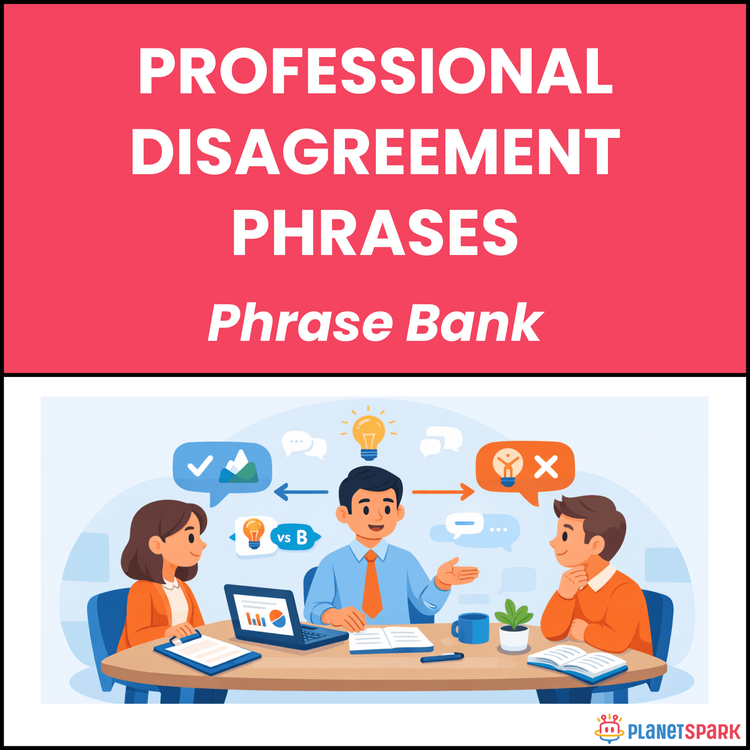
Professional Disagreement Phrases
Professional Disagreement at Work: Confident and Respectful Workplace Communication Guide
Many professionals struggle with one specific moment in workplace conversations: the moment they need to disagree.
You might notice a flaw in a strategy during a meeting, see a risk others are ignoring, or have data that contradicts the direction the team is heading. Yet when the moment arrives, many professionals hesitate. Some stay silent to avoid conflict. Others push back too aggressively and unintentionally damage relationships.
Neither approach serves your career well.
The ability to disagree clearly, confidently, and professionally is one of the most important communication skills in modern workplaces. When done well, it signals strategic thinking, leadership maturity, and credibility.
The Professional Disagreement Phrase toolkit from PlanetSpark was created to help professionals handle these moments with clarity. Instead of struggling to find the right words in high-pressure situations, this resource provides structured phrases, frameworks, and preparation tools that make professional disagreement easier and more effective.
Who Is This Resource For?
This resource is designed for working professionals who want to communicate more confidently in workplace discussions.
It is particularly useful for:
• Early and mid-career professionals who hesitate to challenge ideas in meetings
• Managers who need to provide constructive pushback without damaging team relationships
• Consultants and client-facing professionals navigating high-stakes conversations
• Career switchers entering new industries where communication dynamics may feel unfamiliar
• Professionals who tend to either stay silent or become overly defensive during disagreements
If you have ever left a meeting wishing you had spoken up more clearly, this resource is designed for you.
What Does This Resource Contain?
The Professional Disagreement Phrase toolkit is structured as a practical communication guide that professionals can apply immediately in real workplace situations.
Inside the resource, you will find several structured sections designed to help you navigate disagreements effectively.
Understanding the Spectrum of Disagreement
One of the core ideas in the resource is that not all disagreements are equal. The toolkit explains that effective professionals adjust their communication style depending on the stakes and the situation.
The framework introduces three levels of disagreement:
Gentle Redirect
Used in low-stakes situations where the goal is to introduce another perspective while preserving relationships.
Clear Challenge
Used when you need to assert a different viewpoint in a respectful but direct way.
Firm Stance
Used in high-stakes situations where you must clearly and confidently hold your position.
Understanding this spectrum helps professionals avoid the two most common communication mistakes: pushing back too softly or confronting too aggressively.
Situation-Based Phrase Banks
One of the most practical parts of the resource is a ready-to-use phrase bank organized by disagreement intensity.
These phrases help professionals:
• Introduce alternative perspectives during brainstorming sessions
• Challenge assumptions or data in strategy discussions
• Push back respectfully with senior stakeholders
• Escalate concerns appropriately when decisions carry significant risk
For example, the resource includes phrases designed to open conversations constructively, question assumptions, or invite further discussion rather than creating conflict.
The 5-Point Readiness Checklist
Before speaking up in a disagreement, preparation matters.
The toolkit includes a quick mental checklist professionals can use before raising concerns in meetings or conversations.
The checklist helps you clarify:
• What your actual disagreement is
• The appropriate intensity level for the situation
• The evidence or reasoning supporting your view
• The outcome you want from the conversation
• The relationship and power dynamics involved
Running through this checklist helps transform emotional reactions into thoughtful, strategic communication.
The Disagreement Formula
Instead of relying only on memorized phrases, the resource also teaches a simple structure professionals can use to construct their own responses.
The formula includes four steps:
Acknowledge
Position
Reason
Invite
For example, a professional might acknowledge the other person’s viewpoint, state their perspective, provide reasoning, and invite discussion.
This structure allows professionals to challenge ideas while still keeping the conversation collaborative and constructive.
Real-World Case Example
The resource also includes a practical workplace example illustrating how structured communication changes outcomes.
In the case study, a marketing manager disagrees with a senior leader’s proposal to cut the content budget significantly. Instead of reacting emotionally, she presents her disagreement using evidence and a structured phrase, which leads to a more thoughtful discussion and a better final decision.
The example demonstrates how the right wording can transform disagreement from conflict into strategic contribution.
Common Mistakes Professionals Make When Disagreeing
Another useful section highlights phrases that unintentionally weaken credibility.
For instance, many professionals begin disagreements with statements like:
“I could be wrong, but…”
“I don’t want to be difficult, but…”
These phrases undermine confidence before the argument is even made. The resource replaces them with stronger alternatives that communicate concern without apologizing for having a perspective.
Situation-Specific Communication Guidance
Workplace conversations happen in many contexts, and each requires a slightly different tone.
The resource provides quick-reference guidance for situations such as:
• Team meetings
• Client calls
• Performance reviews
• Email discussions
• Conversations with senior leadership
• Cross-functional collaboration meetings
This helps professionals adapt their language based on context, power dynamics, and audience expectations.
Self-Evaluation and Practice Exercises
The toolkit also includes a short self-assessment that helps professionals evaluate their current communication strengths.
It prompts reflection on areas such as:
• Clarity when expressing disagreement
• Ability to support views with evidence
• Choosing the correct level of pushback
• Maintaining composure under pressure
The resource then encourages a 30-day practice challenge where professionals deliberately apply these phrases in real conversations.
Summary of the Resource
In simple terms, The Professional Disagreement Phrase toolkit is a practical communication guide that teaches professionals how to challenge ideas without damaging relationships.
Instead of avoiding disagreement or creating unnecessary conflict, the resource shows how to:
• Express alternative viewpoints clearly
• Maintain credibility in professional conversations
• Match communication style to the situation
• Support arguments with logic and evidence
• Encourage productive dialogue rather than defensive reactions
For professionals who want to be heard in meetings, strategy discussions, and leadership conversations, this toolkit provides the exact language and frameworks needed.
How Will This Resource Be Useful?
Professionals who apply the principles from this toolkit often experience several immediate benefits.
First, it improves confidence during meetings. When you have structured language ready, you are less likely to freeze or second-guess yourself.
Second, it increases professional credibility. Thoughtful disagreement signals analytical thinking and leadership maturity.
Third, it improves decision-making within teams. When people feel safe to challenge ideas constructively, organizations avoid costly mistakes and blind spots.
Finally, it strengthens professional relationships. Respectful disagreement builds trust because colleagues know you care about outcomes rather than personal wins.
How Should You Use This Resource?
To get the most value from this toolkit, approach it as a practical communication training guide rather than just reading material.
Step 1: Read the full resource once to understand the core frameworks and communication philosophy.
Step 2: Identify the phrases that feel natural to your speaking style and note them.
Step 3: Practise a few phrases aloud before entering important meetings.
Step 4: Use the readiness checklist before high-stakes conversations where disagreement may arise.
Step 5: Apply the disagreement formula when crafting responses in emails or written communication.
Step 6: Reflect on how your conversations change as you begin using more structured language.
Over time, these phrases will become second nature.
Action Steps
If you want to immediately improve how you handle disagreements at work, start with these simple actions:
1. Identify one upcoming meeting where you may need to challenge an idea.
2. Choose one phrase from the toolkit that fits that situation.
3. Prepare one piece of evidence or reasoning to support your perspective.
4. Use the Acknowledge → Position → Reason → Invite structure when speaking.
5. Reflect after the conversation and adjust your phrasing for next time.
Consistent practice is what turns communication frameworks into real professional skills.
Professional growth often depends on more than technical expertise. It depends on how effectively you communicate your thinking in moments that matter.
The professionals who build influence inside organizations are not those who avoid disagreement. They are the ones who express their perspectives with clarity, respect, and strategic intent.
Learning how to disagree professionally ensures your ideas are heard without damaging relationships or credibility.