Remote Work Positioning Blurbs

Remote Work Positioning Blurbs
Remote Work Positioning Blurbs Toolkit: 30+ Templates for LinkedIn, Resumes, and Client Pitches
Remote work has shifted from a temporary arrangement to a permanent operating model for many organizations. Yet despite working successfully in distributed teams, many professionals struggle to describe their remote work capability in a way that resonates with hiring managers, recruiters, and clients.
Instead of demonstrating real remote work competence, most professionals rely on vague statements like “self-motivated,” “comfortable working from home,” or “proficient in Zoom and Slack.” Unfortunately, those phrases communicate very little about how someone actually performs in a remote environment.
This is where positioning becomes critical.
A well-written remote work positioning blurb helps you communicate your remote identity, working style, and value in just a few sentences. Whether it appears in a LinkedIn headline, resume summary, networking email, or client proposal, the right blurb can immediately signal that you are someone who thrives in distributed teams.
The Remote Work Positioning Blurbs resource was created to help professionals solve a very specific problem: you know you work effectively in remote environments, but you may not know how to express that clearly and persuasively.
The resource includes practical frameworks, ready-to-use templates, and a structured worksheet so you can craft powerful positioning statements quickly and confidently.
Who Is This Resource For?
This resource is designed specifically for working professionals who are navigating remote or hybrid work environments and want to communicate their value more clearly.
It is especially useful for:
Career changers transitioning into remote roles and needing to reframe transferable skills.
Early-career professionals who want to demonstrate remote capability despite limited experience.
Mid-career professionals who have worked remotely but have never positioned that experience strategically.
Consultants and freelancers who must build trust with clients they may never meet in person.
Managers and team leaders responsible for leading distributed teams across time zones.
Professionals with 0–15 years of experience who want to strengthen their career positioning in the modern remote workplace.
If your career includes remote collaboration, distributed teams, or digital-first communication, this resource can help you articulate that experience in a way that stands out.
What Does This Resource Contain?
The Remote Work Positioning Blurbs toolkit is structured as a practical guide with templates, frameworks, and exercises designed to help you craft powerful positioning statements quickly.
Inside the resource, you will find:
30+ Ready-to-Use Blurb Templates
Templates for LinkedIn headlines, resumes, cover letters, client proposals, interviews, networking emails, and professional bios.
The R.E.A.C.H. Positioning Framework
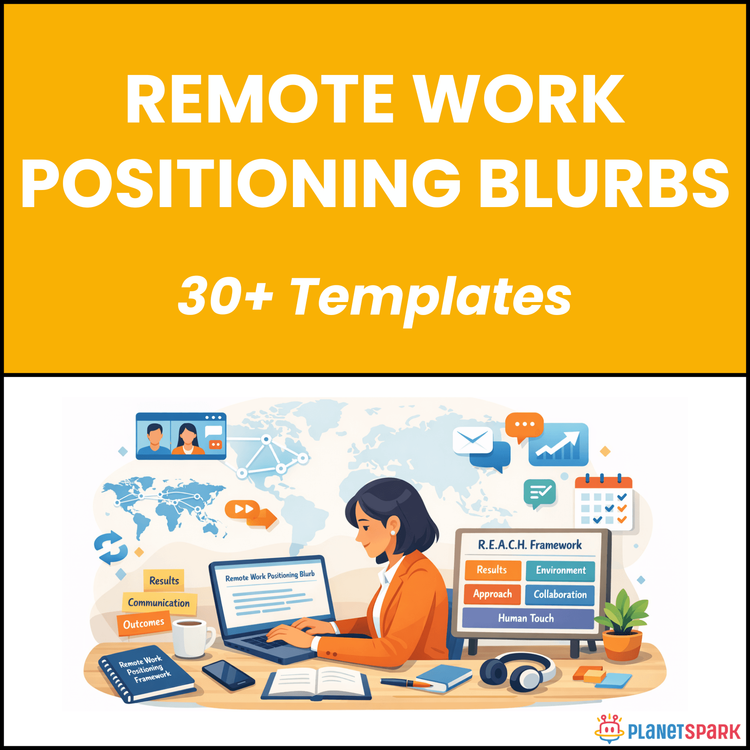
A structured model for understanding your remote work identity through five dimensions: Results, Environment, Approach, Collaboration, and Human Touch.
Four Blurb Formats
Guidance on choosing the correct format depending on where your blurb will appear, including Micro blurbs, Summary blurbs, Pitch blurbs, and Story blurbs.
Power Words for Remote Work
A curated vocabulary list that helps professionals replace generic language with high-signal phrases that demonstrate real remote work competence.
The 3-Part Blurb Construction Formula
A simple structure for writing effective blurbs using a Context Anchor, Approach Signal, and Value Hook.
A Signature Blurb Worksheet
A guided exercise that helps you build your own positioning statement step-by-step.
Practical Checklists and Self-Evaluation Tools
Tools to review, refine, and improve your positioning before publishing it.
Real-World Case Example
A practical example showing how a professional transformed a generic profile summary into a compelling remote work positioning statement.
By combining templates with frameworks and exercises, the resource makes it easier for professionals to craft blurbs that feel authentic and impactful.
Summary of the Resource
At its core, this resource teaches professionals how to clearly communicate one of the most important career skills today: the ability to work effectively in distributed environments.
Instead of leaving remote work experience implied or vaguely described, the toolkit helps you:
Translate your remote experience into clear professional positioning.
Craft short but powerful blurbs for different career contexts.
Replace generic language with specific systems, practices, and outcomes.
Build consistent positioning across LinkedIn, resumes, proposals, and interviews.
Develop a repeatable framework you can use throughout your career.
The result is a complete system for articulating your remote work identity with clarity and confidence.
How Will This Resource Be Useful?
Professionals often underestimate how much their career opportunities depend on how clearly they communicate their strengths.
This resource helps bridge that gap.
By using the frameworks and templates provided, you can:
Stand out in competitive remote job markets.
Increase your chances of getting interview callbacks.
Present yourself more confidently on LinkedIn and professional platforms.
Build trust with remote clients and collaborators.
Communicate your remote working style clearly to teams and managers.
One of the key insights from the resource is that remote work positioning is no longer optional. With remote roles attracting significantly more applicants than traditional office roles, professionals who articulate their remote capability clearly often gain a significant advantage.
In short, the ability to explain how you operate remotely is now a career asset in itself.
How Should You Use This Resource?
The resource is designed to be both a quick reference guide and a deeper positioning toolkit.
Here is the recommended way to approach it.
Start with the framework
Begin by understanding the R.E.A.C.H. framework, which helps you identify the most important aspects of your remote work identity.
Identify your professional profile
Determine whether you are positioning yourself as a career changer, early-career professional, consultant, manager, or executive.
Choose the right blurb format
Select the format that matches your context: LinkedIn headline, resume summary, cover letter, interview introduction, or proposal bio.
Use the templates as a starting point
Customize one of the 30+ templates using your own experience, results, and working style.
Build your signature blurb
Use the worksheet to assemble a personalized positioning statement that reflects your unique professional story.
Adapt across platforms
Once you have a strong summary blurb, adapt it into shorter or longer versions for different platforms and contexts.
Using this process allows you to create multiple versions of your positioning statement without starting from scratch each time.
Action Steps
If you want to apply this resource immediately, start with these simple steps.
1. Complete the signature blurb worksheet to capture your remote work experience and habits.
2. Identify your core positioning statement using the 3-part blurb formula.
3. Customize one template for your LinkedIn headline or About section.
4. Adapt that statement into a resume summary or proposal introduction.
5. Run your blurb through the checklist to ensure it includes clear context, approach, and value.
6. Share it with a colleague or mentor to gather feedback.
7. Update your professional profiles and track engagement or responses over the next few weeks.
Even a small improvement in how you describe your remote capability can significantly improve how others perceive your professional value.
The way you communicate your work is often just as important as the work itself. In a world where distributed teams are becoming the norm, professionals who can clearly articulate how they operate remotely will always stand out.
Remote work positioning is not about exaggerating your experience — it is about explaining it clearly, strategically, and confidently. When you do that well, your profile becomes more compelling, your applications become stronger, and your opportunities expand.