
Returnship Positioning Summaries

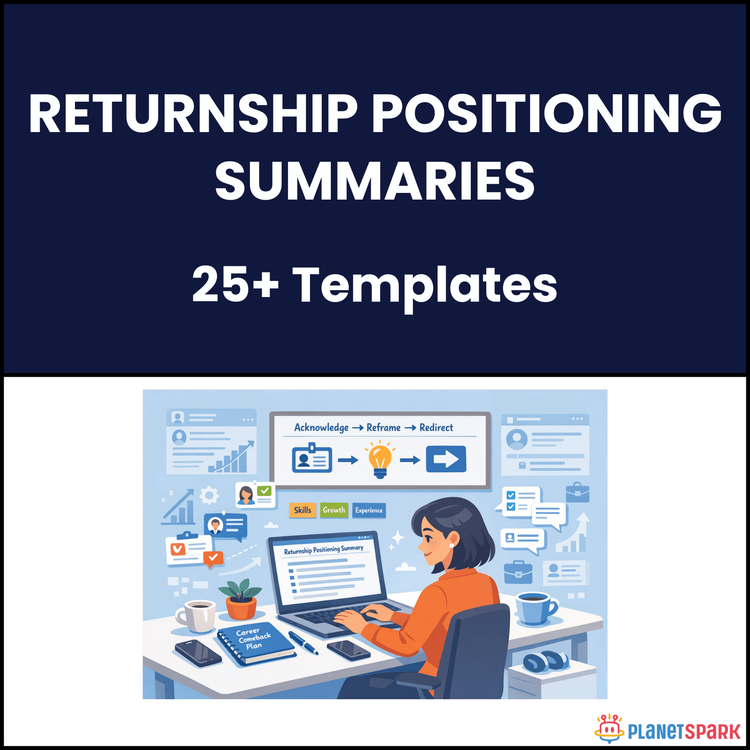
Returnship Positioning Summaries
Powerful Returnship Positioning Summary After a Career Break (25+ Templates Included)
Returning to work after a career break can feel surprisingly complicated.
You may have years of experience, strong professional skills, and a clear desire to contribute again — yet the moment you begin updating your résumé or LinkedIn profile, one question often creates hesitation:
How do you explain the gap?
Many professionals returning after a break struggle not because they lack ability, but because they lack the right narrative. They either over-explain their break, underplay it, or avoid mentioning it entirely. Unfortunately, this often leaves recruiters and hiring managers with unanswered questions.
This is exactly where a well-crafted returnship positioning summary becomes powerful.
A positioning summary is the short statement at the top of your résumé, LinkedIn profile, or cover letter that explains who you are professionally and why you are valuable right now. It is not an apology for a break — it is a strategic narrative about your experience, growth, and future contribution.
The Returnship Positioning Summary toolkit was designed specifically to help professionals re-enter the workforce with clarity, confidence, and a compelling professional story. It provides structured frameworks, practical worksheets, and more than 25 ready-to-use templates for different return scenarios.
Who Is This Resource For?
This resource is designed for professionals who are planning to return to the workforce after a career break and want to communicate their story effectively.
It is particularly useful for:
• Professionals returning after caregiving responsibilities
• Individuals who paused their careers due to health or personal recovery
• Professionals who relocated internationally or experienced visa delays
• Individuals who used their break to pursue education, certifications, or upskilling
• Freelancers, consultants, or entrepreneurs transitioning back to employment
• Career switchers using their break as an opportunity to pivot industries
• Professionals who spent time volunteering or working in the non-profit sector
• Individuals returning after extended or multi-reason career breaks
In short, if you are re-entering the workforce and want to present your experience confidently rather than defensively, this resource is designed for you.
What Does This Resource Contain?
The Returnship Positioning Summary toolkit is structured as a practical step-by-step guide that helps professionals turn their career break into a compelling professional narrative.
Inside the resource, you will find:
A Proven 3-Part Positioning Formula
The core framework used throughout the resource is a three-step structure designed to create confident, forward-focused positioning summaries:
Acknowledge → Reframe → Redirect
This formula helps professionals introduce their expertise, briefly explain the break, and then shift the focus to their future contribution.
25+ Ready-to-Use Positioning Templates
The toolkit includes more than 25 positioning summary templates across eight common return-to-work scenarios.
These include templates for:
• Caregiving returners
• Health or recovery-related breaks
• Relocation and visa gaps
• Education and upskilling breaks
• Freelancers and entrepreneurs returning to employment
• Industry switchers
• Volunteer or non-profit work returners
• Extended or complex career breaks
Each template follows the same strategic structure but adapts language and emphasis based on the type of break and career context.
Worksheets to Build Your Own Summary
The resource also includes structured exercises that help professionals create a personalized positioning summary.
Key worksheets include:
• The Positioning Summary Builder
• A break-to-skills mapping exercise
• A reflection worksheet for identifying transferable skills
• A structured template for combining identity, break narrative, and forward value
A 10-Point Quality Checklist
Before publishing your summary on LinkedIn or your résumé, the toolkit provides a checklist to ensure it meets professional standards.
This checklist ensures your summary:
• Starts with a clear professional identity
• Mentions the break briefly without apology
• Connects the break to professional value
• Ends with a forward-looking value proposition
• Uses confident and results-focused language.
Real Case Studies and Examples
The resource includes real-world examples of professionals who improved their positioning summaries and saw better recruiter engagement.
For example, one marketing professional transformed a weak summary that focused on her career gap into a confident narrative that highlighted her expertise and skills gained during a caregiving break. The revised version led to multiple recruiter outreach messages within weeks.
Platform Adaptation Guide
The toolkit also explains how to adapt your positioning summary for different contexts, including:
• LinkedIn profiles
• Résumé summaries
• Cover letters
• Networking introductions
• Recruiter emails
This ensures your narrative remains consistent but tailored for each platform.
Summary of the Resource
If you are short on time, here is the essence of what this resource provides.
The Returnship Positioning Summary toolkit helps professionals:
• Turn a career break into a professional asset rather than a liability
• Write a confident positioning summary for LinkedIn, résumés, and applications
• Use proven frameworks to explain career gaps strategically
• Adapt their narrative for different job search platforms
• Build confidence when returning to the workforce
Instead of guessing how to explain your break, the toolkit gives you ready-to-use language, templates, and frameworks to position yourself effectively.
How Will This Resource Be Useful?
The biggest challenge returners face is not their capability — it is how they communicate their story.
This resource helps solve that problem in several practical ways.
It Helps You Control Your Narrative
A career break does not need to be a weakness in your profile. When positioned correctly, it can highlight resilience, adaptability, leadership, and new perspectives.
It Builds Confidence in Professional Communication
Many professionals feel uncomfortable discussing their break. The templates and frameworks in this resource help replace uncertainty with clear, confident language.
It Saves Time During the Job Search
Instead of writing summaries from scratch for every application, professionals can start with proven templates and customise them quickly.
It Improves Recruiter Engagement
A well-written positioning summary makes your profile more compelling and easier for recruiters to understand — increasing the likelihood of profile views, recruiter messages, and interview invitations.
How Should You Use This Resource?
To get the most value from the toolkit, it is helpful to approach it as a structured process rather than simply reading through it once.
Step 1: Review the Framework
Start by understanding the three-part positioning formula: acknowledge your expertise, briefly reframe the break, and redirect the reader to your future value.
Step 2: Explore the Templates
Browse the 25+ templates and identify two or three that most closely match your situation.
Step 3: Use the Worksheets
Complete the reflection and positioning builder worksheets to draft your personalized summary.
Step 4: Refine and Test
Share your draft with a mentor, peer, or career advisor and refine the language based on feedback.
Step 5: Adapt for Different Platforms
Modify your summary for LinkedIn, your résumé, cover letters, and networking introductions.
Step 6: Deploy and Track Results
Publish your updated summary and track recruiter responses, profile views, and interview invitations over the next few weeks.
Action Steps
If you want to start improving your professional narrative today, here are a few simple steps you can take.
1. Identify the main reason for your career break.
2. Choose the template category that best matches your situation.
3. Write a first draft using the three-part positioning formula.
4. Keep your summary between 60 and 100 words.
5. Focus on professional identity and future contribution rather than explaining the past in detail.
6. Test the summary on LinkedIn or your résumé.
7. Refine the language based on recruiter feedback and engagement.
Returning to work after a break can feel daunting, but the right narrative can change everything.
Your career break is not a flaw in your story — it is simply one chapter of it. When you frame that chapter with confidence, clarity, and purpose, hiring managers begin to see what really matters: your experience, your perspective, and the value you bring to the role.