Class 5 Worksheet on Inner and Outer Dialogue
Class 5Free DownloadPDF

Simarpreet KaurVisit Profile
I am a dedicated and student-focused educator with over 5 years of experience teaching. Currently, I am working as a teacher at Planet Spark. I love teaching at Planet Spark because the interactive, one-on-one teaching format and curriculum quality, that’s easy to follow and effective.
Class 5 Worksheet on Inner and Outer Dialogue
Class 5Free DownloadPDF
Simarpreet KaurVisit Profile
I am a dedicated and student-focused educator with over 5 years of experience teaching. Currently, I am working as a teacher at Planet Spark. I love teaching at Planet Spark because the interactive, one-on-one teaching format and curriculum quality, that’s easy to follow and effective.
Voices Inside & Out: Mastering Inner and Outer Dialogue for Grade 5
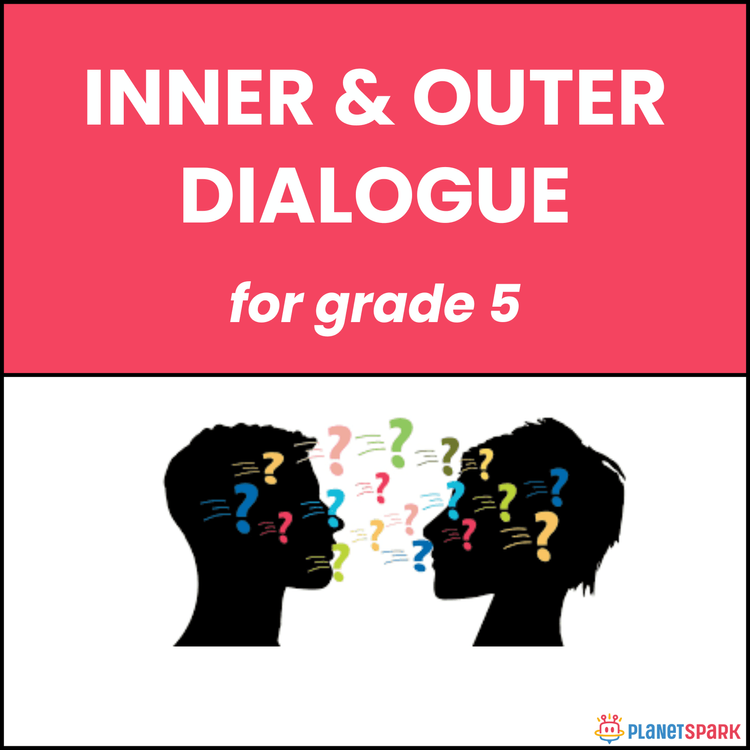
This Grade 5 grammar and narrative writing worksheet focuses on helping learners understand and correctly use inner and outer dialogue in storytelling. Through clear explanations and scaffolded exercises, students learn the difference between what characters say aloud (outer dialogue) and what they think silently (inner dialogue).
Designed specifically for Grade 5 learners, this worksheet builds strong narrative writing skills by combining grammar understanding with creative expression. Students begin by learning how dialogue works in stories, including the correct use of quotation marks for outer dialogue and thought representation for inner dialogue.
The worksheet includes engaging, age-appropriate activities such as identifying inner and outer dialogue, labeling sentences using “I” and “O”, adding original inner and outer dialogue lines to given situations, and finally writing a mini narrative that blends both types of dialogue naturally.
Why Inner and Outer Dialogue Matter in Grammar?
Inner and outer dialogue play an important role in storytelling and narrative writing because:
1. They help readers understand characters’ thoughts, feelings, and actions.
2. Outer dialogue shows conversations using quotation marks.
3. Inner dialogue reveals emotions and ideas without spoken words.
4. Using both makes stories more engaging, expressive, and realistic.
What’s Inside This Worksheet?
This worksheet includes four structured activities that gradually build mastery:
🧠 Exercise 1 – Read and Understand Dialogue
Students learn the definitions of inner and outer dialogue with clear examples to build foundational understanding.
✏️ Exercise 2 – Identify the Dialogue
Students label each sentence as Inner (I) or Outer (O), strengthening recognition skills through practical examples.
📝 Exercise 3 – Add Inner and Outer Dialogue
Students write one inner and one outer dialogue sentence for each given situation, encouraging creativity and application.
📖 Exercise 4 – Write a Mini Narrative
Students write a short story that includes at least two inner and two outer dialogue examples, applying everything they have learned in a meaningful writing task.
🔹 Answer Key
Exercise 1 – Read and Understand Dialogue
(Concept-based reading task – no written answers required)
Exercise 2 – Identify the Dialogue (Write “I” or “O”)
1. I
2. O
3. I
4. O
5. I
6. O
7. O
8. I
9. O
10. I
Exercise 3 – Add One Inner and One Outer Dialogue
(Sample Answers)
1. The dog runs quickly in the park
Outer: “Come back here!” shouted the boy.
Inner: I hope he doesn’t run too far.
2. We are eating sandwiches at the picnic
Outer: “These sandwiches are delicious,” said my friend.
Inner: I wish we could stay here longer.
3. The baby sleeps peacefully in her crib
Outer: “She finally fell asleep,” whispered her mother.
Inner: I hope she doesn’t wake up now.
4. My father was fixing the broken fence
Outer: “This should hold for now,” my father said.
Inner: I wonder if he needs my help.
5. I am reading a mystery book
Outer: “This part is so exciting,” I said aloud.
Inner: I think I know who the culprit is.
Exercise 4 – Mini Narrative Writing
Student-generated response
Answers may vary.
Build your child’s storytelling confidence with structured dialogue practice and expert-guided learning support.
🔖Book a free trial!
Frequently Asked Questions
Inner dialogue shows a character’s thoughts, while outer dialogue includes spoken words with quotation marks.
Children should use correct punctuation, speaker tags, and new lines for each speaker to keep conversations easy to follow.
It reveals emotions and motivations that are not spoken aloud, helping readers understand a character’s decisions.