Class 5 Quotation Marks Worksheet for Dialogue
Class 5EnglishEnglish GrammarFree DownloadPDF

Neha KhanVisit Profile
I am an enthusiastic and dedicated English educator at PlanetSpark. I am passionate about helping students develop strong communication and public speaking skills while building their confidence and creativity. My teaching approach focuses on making learning fun, interactive, and meaningful so that every student feels inspired to express themselves effectively in English.
Class 5 Quotation Marks Worksheet for Dialogue
Class 5EnglishEnglish GrammarFree DownloadPDF
Neha KhanVisit Profile
I am an enthusiastic and dedicated English educator at PlanetSpark. I am passionate about helping students develop strong communication and public speaking skills while building their confidence and creativity. My teaching approach focuses on making learning fun, interactive, and meaningful so that every student feels inspired to express themselves effectively in English.
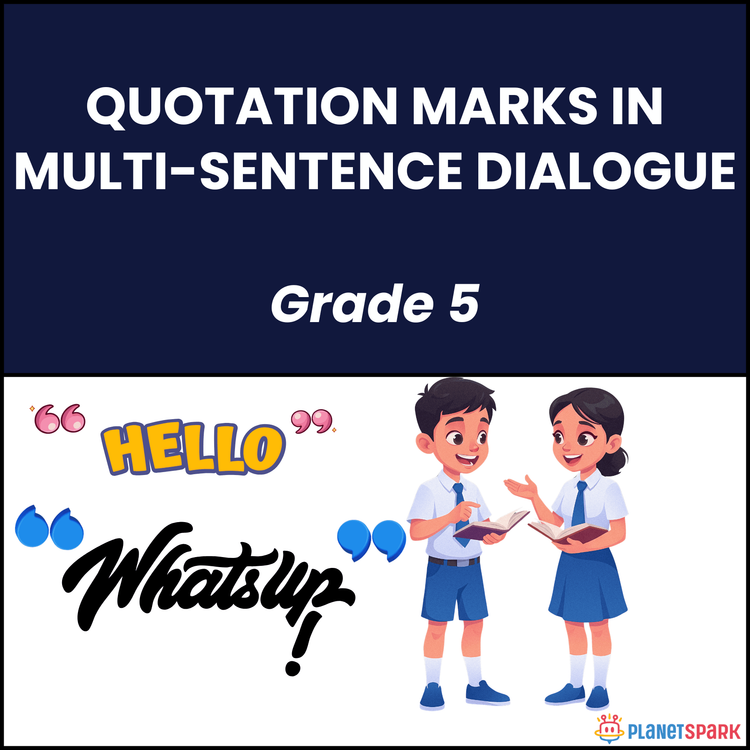
Mastering Dialogue Writing: Quotation Marks in Multi-Sentence Dialogue for Class 5
This Grade 5 worksheet focuses on helping students correctly use quotation marks in multi-sentence dialogue. It introduces learners to proper punctuation rules when characters speak more than one sentence, making their writing clearer and grammatically accurate.
Why Quotation Marks Matter in Grammar?
Quotation marks are essential for showing spoken words in writing. For Grade 5 learners, this topic is important because:
1. It helps clearly separate dialogue from the rest of the sentence.
2. It teaches correct punctuation in multi-sentence speech.
3. It improves storytelling and conversation writing skills.
4. It builds confidence in both creative and formal writing.
What’s Inside This Worksheet?
This worksheet includes five engaging exercises designed to strengthen understanding of dialogue punctuation:
Exercise 1 – Multiple Choice Questions
Students choose the correctly punctuated sentence where quotation marks are used properly in multi-sentence dialogue.
Exercise 2 – True or False
Students identify whether each sentence correctly uses quotation marks in dialogue.
Exercise 3 – Fill in the Blanks
Students insert quotation marks in the correct places within sentences.
Exercise 4 – Sentence Rewriting
Students rewrite sentences using appropriate reporting verbs and correct dialogue punctuation.
Exercise 5 – Paragraph Writing
Students read a passage and add quotation marks correctly to complete the dialogue.
Answer Key (For Parents & Educators)
Exercise 1 – Multiple Choice Answers
1. b 2. a 3. c 4. a 5. b
6. c 7. c 8. a 9. b 10. c
Exercise 2 – True/False
1. False
2. False
3. False
4. True
5. False
6. True
7. True
8. False
9. False
10. True
Exercise 3 – Fill in the Blanks (Quotation Marks)
1. "We will play cricket,"
2. "Bring your book. Read page five."
3. "Finish the work. Then check it."
4. "Please hurry up. The bus is here."
5. "Meet me later. We will study."
6. "Open your books. Read quietly."
7. "Please bring the bat. Start the match."
8. "Clean the board. Sit down."
9. "Kindly write the answer. Check again."
10. "Come fast. Do not be late."
Exercise 4 – Rewritten Sentences
1. Riya requested, "Please come soon. Bring the ball," to Ravi.
2. Raj asked, "Bring the bat. Start now," to Ravi.
3. The teacher called, "Open the book. Read aloud," to the class.
4. Meera told, "Finish the work. Check again," to Asha.
5. Ravi shouted, "Come fast. Start practice," to Raj.
6. Asha replied, "Meet later. Study together," to Meera.
7. Riya told, "Pack the bag. Leave soon," to Raj.
8. Meera said, "Write neatly. Check again," to Asha.
9. Raj asked, "Come early. Bring snacks," to Ravi.
10. Ravi called, "Stand straight. Listen now," to the class.
Exercise 5 – Paragraph Writing (Quotation Marks Inserted)
"Come early tomorrow. We will practice dance," said Riya.
"I will come early. We will practice well," said Meera.
"Come early tomorrow. We will practice our dance for the annual day," said Riya.
"I will come early. We will practice well and finish all the steps," replied Meera.
"That sounds exciting. I would love to watch your dance," said Anaya.
"You can help us practice too. It will be fun," said Riya.
"Of course. I will come early tomorrow as well," replied Anaya.
"See you tomorrow at school."
Help your child write perfect dialogues with confidence and clarity through guided practice.
Frequently Asked Questions
Each spoken sentence begins with a capital letter and is enclosed in quotation marks, with punctuation placed inside the quotes.
Use commas before or after dialogue tags like said or asked, and keep them outside the quotation marks when needed.
They often forget where to place commas and capital letters, so guided practice helps build correct usage.