Class 5 Worksheet on Compound Subject Agreement
Class 5English GrammarEnglishFree DownloadPDF

Ramanjeet KaurVisit Profile
I am a content creator with a background in school teaching and educational content development. Having worked as a content creator with PlanetSpark, I specialize in developing engaging, age-appropriate learning materials that strengthen students’ English writing, grammar, and communication skills. I focus on clarity, creativity, and building confidence in young learners through structured and effective language instruction.
Class 5 Worksheet on Compound Subject Agreement
Class 5English GrammarEnglishFree DownloadPDF
Ramanjeet KaurVisit Profile
I am a content creator with a background in school teaching and educational content development. Having worked as a content creator with PlanetSpark, I specialize in developing engaging, age-appropriate learning materials that strengthen students’ English writing, grammar, and communication skills. I focus on clarity, creativity, and building confidence in young learners through structured and effective language instruction.
Compound Power: Mastering Subject–Verb Agreement for Grade 5
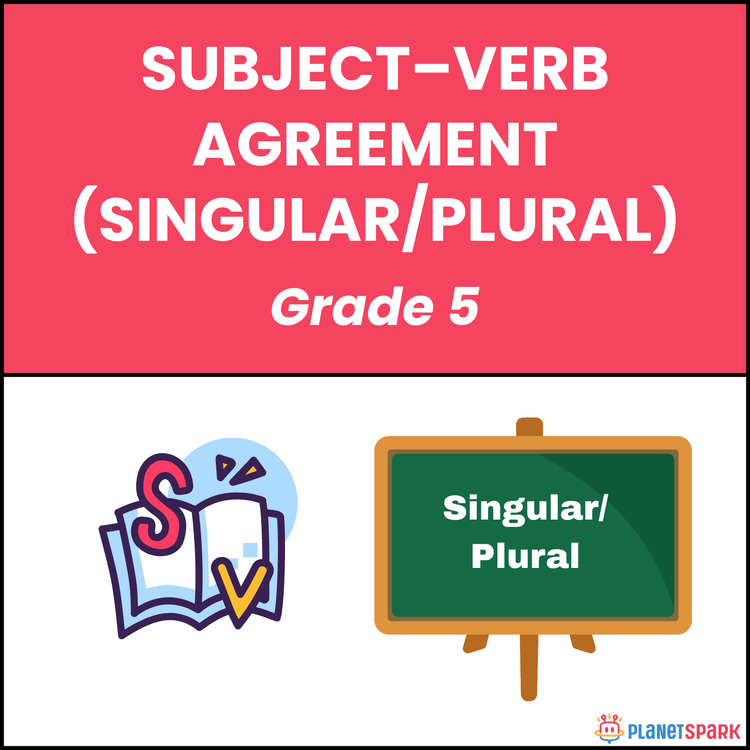
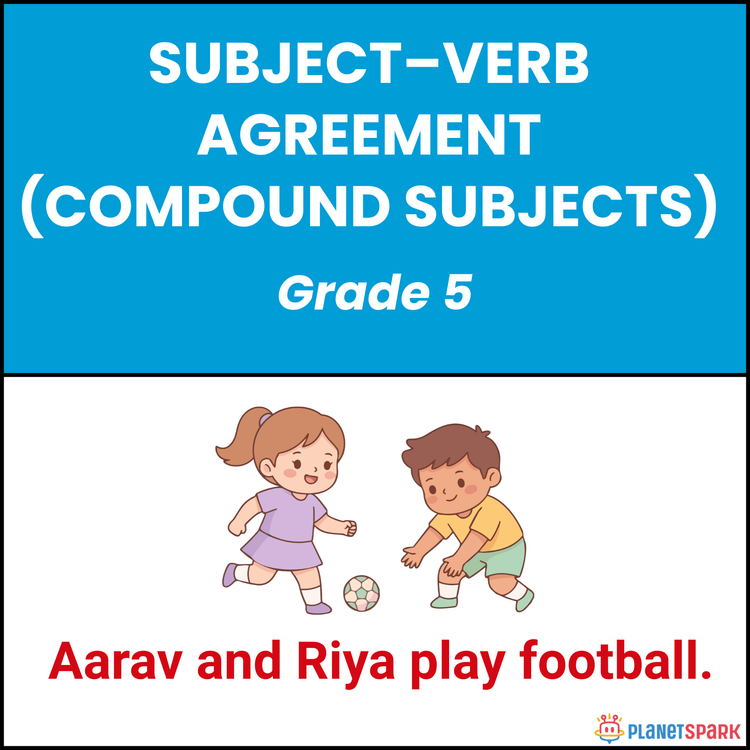
This Grade 5 grammar worksheet focuses on Subject–Verb Agreement with Compound Subjects, helping students understand how verbs change when more than one subject is joined using words like and, or, and nor. Through clear examples and structured practice, learners build confidence in choosing verbs that correctly match compound subjects.
Why Subject–Verb Agreement with Compound Subjects Matters in Grammar?
Understanding how verbs agree with compound subjects is an important step in building strong grammar skills for Grade 5 learners because:
1. Compound subjects joined with “and” usually take plural verbs.
2. Subjects connected with “or” or “nor” follow agreement rules based on the subject closest to the verb.
3. Correct subject–verb agreement improves sentence clarity and grammar accuracy.
4. These rules help students write better sentences in both speaking and writing tasks.
What’s Inside This Worksheet?
This worksheet includes five grammar-rich activities designed to help learners practise subject–verb agreement with compound subjects in engaging ways.
Exercise 1 – True or False
Students read sentences containing compound subjects and decide whether the verb agrees correctly with the subject. They mark each sentence as True or False based on correct verb usage.
Exercise 2 – Multiple Choice Questions
Each question provides two sentence options. Students select the one that correctly follows subject–verb agreement rules for compound subjects.
Exercise 3 – Fill in the Blanks
Learners complete sentences by choosing the correct verb from the given options. This exercise helps them apply agreement rules with different compound subject patterns.
Exercise 4 – Underline and Rewrite
Students underline the correct verb from two options and then rewrite the full sentence correctly, reinforcing proper subject–verb agreement.
Exercise 5 – Paragraph Fill in the Blanks
A short paragraph about a school picnic contains several blanks. Students fill in each blank with the correct verb form from the options provided, applying compound subject rules in a real-life context.
This worksheet teaches subject–verb agreement with compound subjects, helping students learn how verbs change when two or more subjects are joined with words like “and,” “or,” and “nor.”
Answer Key (For Parents & Educators)
Exercise 1 – True or False
1. True
2. True
3. False
4. False
5. True
6. False
7. True
8. False
9. False
10. True
Exercise 2 – Multiple Choice Questions
1. b) Shyam and Priya are buying fruits.
2. a) Meera and Ina were flying a kite.
3. a) The dog and the cat run in the yard.
4. b) Isha and I pluck mangoes from the tree.
5. a) Tina and Riya practise songs for the assembly.
6. b) Pooja and her brothers are at school.
7. b) Aarav and I enjoy dancing in the rain.
8. a) Either the cat or the dog is making that noise.
9. b) Shyam and you water the plants in the garden.
10. a) Rahul and Meenu do homework daily.
Exercise 3 – Fill in the Blanks
1. is
2. are
3. cause
4. tastes
5. play
6. perform
7. prepare
8. are
9. read
10. wins
Exercise 4 – Correct Sentences
1. The teacher and the student are talking.
2. Kabir and Raj enjoy playing hockey.
3. Neither the dog nor the cats like to take a bath.
4. Seema and Ashima eat lunch at two o’clock.
5. Anvi and I are happy to see our friend.
6. The cookies and the cake smell delicious.
7. Prachi and Amit love reading books.
8. Either I or my brother cleans the kitchen at night.
9. Rice and beans is a common dish.
10. Tomatoes and onions are in the basket.
Exercise 5 – Paragraph Completion
are, is, bring, organise, want, are, make, are, want, were
Strengthen your child’s grammar accuracy and writing confidence with engaging compound subject practice and expert-led communication training.
Frequently Asked Questions
Compound subjects require a plural verb, even if the subjects are joined by "and."
Students sometimes treat compound subjects as singular, leading to verb errors.
By providing compound subject sentences where students choose the correct verb form.