Class 1 Punctuation Worksheet on Using Commas to Separate Items in a List
Class 1English GrammarSpoken EnglishFree DownloadPDF

Aishwarya VijayVisit Profile
I’m a former banking and finance professional with 6 years of corporate experience, now a certified educator working at PlanetSpark. After completing my ECCEd and teaching coding at WhiteHat Jr for 2.5 years, I transitioned fully into teaching to build a healthier work–life balance and be more present for my son—while doing work I genuinely love.
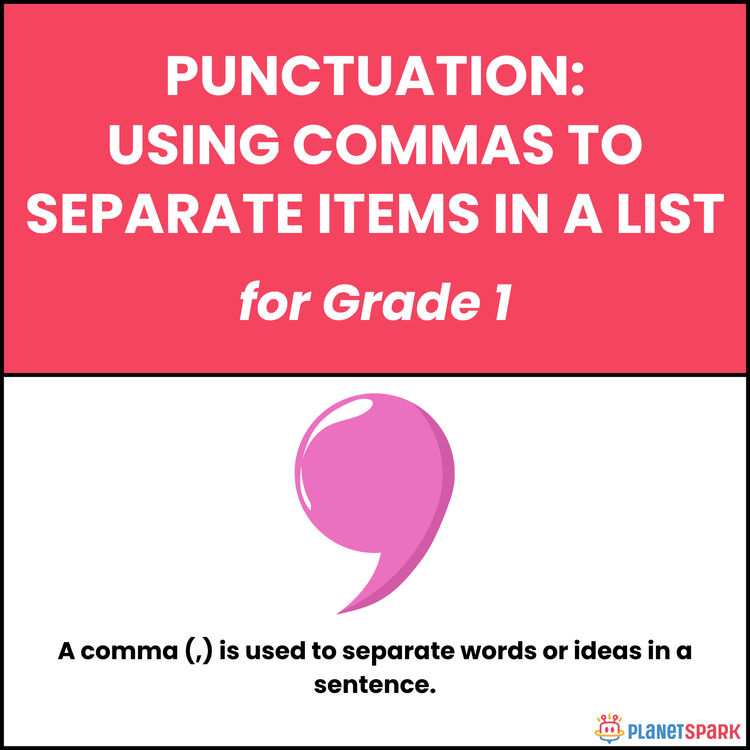
Class 1 Punctuation Worksheet on Using Commas to Separate Items in a List
Class 1English GrammarSpoken EnglishFree DownloadPDF
Aishwarya VijayVisit Profile
I’m a former banking and finance professional with 6 years of corporate experience, now a certified educator working at PlanetSpark. After completing my ECCEd and teaching coding at WhiteHat Jr for 2.5 years, I transitioned fully into teaching to build a healthier work–life balance and be more present for my son—while doing work I genuinely love.
List It Right! Using Commas to Separate Items in a List for Class 1
This Class 1 worksheet teaches children how to correctly use commas to separate three or more items in a list. Students learn that commas help make sentences clearer by showing small pauses between items. With simple, everyday examples and fun repetition, children start to understand why commas matter in writing.
Through MCQs, True/False checks, comma-insertion tasks, sentence rewriting, and a paragraph exercise full of food, school items, and fun objects, students build strong early punctuation skills in an engaging, meaningful way.
Why Commas in Lists Matter?
Understanding comma usage helps children:
1. Write clear and organized sentences.
2. Read lists smoothly with natural pauses.
3. Recognize patterns in sentence structure.
4. Build foundational writing habits for future grammar skills.
What’s Inside This Worksheet?
This worksheet includes five engaging activities:
🧠 Exercise 1 – Choose the Correct List
Students choose the sentence where commas are correctly placed.
✔️ Exercise 2 – True or False
Learners check whether commas are used properly in each list.
✏️ Exercise 3 – Add the Missing Commas
Children rewrite each sentence by inserting commas between list items.
📝 Exercise 4 – Rewrite Correctly
Students rewrite incorrect list sentences using commas properly.
📖 Exercise 5 – Passage Editing
A food-and-friends themed paragraph where children insert commas in multiple lists.
ANSWER KEY
Exercise 1 – Choose the Correct Sentence
1. b
2. c
3. a
4. b
5. b
6. a
7. c
8. b
9. a
10. b
Exercise 2 – True or False
1. True
2. True
3. False
4. True
5. False
6. False
7. False
8. True
9. True
10. True
Exercise 3 – Add Missing Commas
1. I bought apples, bananas and grapes.
2. He carried cups, plates and spoons.
3. She has dolls, cars and blocks.
4. They packed shirts, pants and socks.
5. The box has pens, clips and erasers.
6. We saw cows, goats and buffaloes.
7. Mira ate idli, vada and dosa.
8. She picked mangoes, oranges and lemons.
9. He found beads, stones and shells.
10. The shop has bags, shoes and hats.
Exercise 4 – Rewrite Correctly
1. I have crayons, pencils, erasers.
2. He bought fruits, veggies, snacks.
3. We saw buses, autos, bikes.
4. She packed chips, biscuits, juice.
5. The boy has comics, toys, cards.
6. She found cups, bowls, plates.
7. I ate idli, dosa, pongal.
8. They carried bottles, tiffins, napkins.
9. He brought markers, sketchpens, crayons.
10. We bought apples, pears, bananas.
Exercise 5 – Passage Editing (Add Missing Commas)
Aria opens her lunch box and finds roti, sabzi, and salad inside.
She sits with Kiran, Leela, and Soham to eat together.
They have fruit, biscuits, and juice in their tiffin.
Aria shares her roti, sabzi, and salad happily with her friends.
Leela brings idli, dosa, and chutney from home.
Kiran has apples, grapes, and bananas packed neatly.
Soham brings rice, dal, and curd for his meal.
The children enjoy eating, chatting, and laughing during lunch time.
After finishing their food, they pack their tiffin boxes, water bottles, and napkins before going back to class.
Help your child write clearly and confidently by mastering commas in lists!
Frequently Asked Questions
Commas help separate words or ideas, making simple sentences easier to read.
Encourage children to read sentences aloud and notice natural breaks.
They focus on words more than pauses, so guided practice improves usage.