Class 7 English Worksheet on Ambiguous Sentences
Class 7EnglishEnglish GrammarFree DownloadPDF

D. VaralakshmiVisit Profile
I am an experienced educator with a strong academic background in Electronics and Communication Engineering. With over 9 years of teaching experience 5 years as an Assistant Professor and 4 years as an online teacher , I specialize in simplifying complex concepts and creating structured learning materials that support student understanding and confidence.
Class 7 English Worksheet on Ambiguous Sentences
Class 7EnglishEnglish GrammarFree DownloadPDF
D. VaralakshmiVisit Profile
I am an experienced educator with a strong academic background in Electronics and Communication Engineering. With over 9 years of teaching experience 5 years as an Assistant Professor and 4 years as an online teacher , I specialize in simplifying complex concepts and creating structured learning materials that support student understanding and confidence.
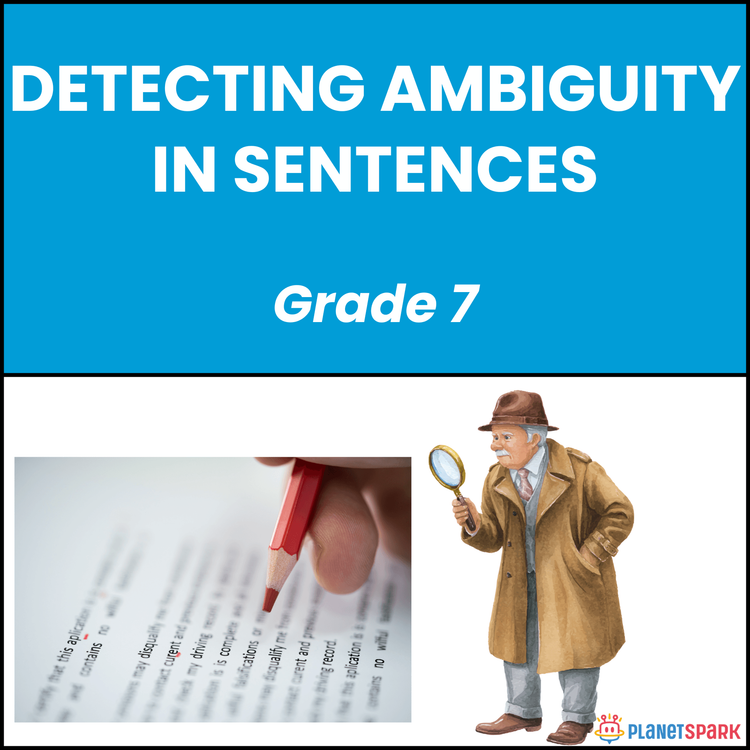
**Detecting Ambiguity in Sentences for Grade 7**
This Grade 7 worksheet focuses on identifying and fixing ambiguous sentences. It aims to help students understand how ambiguity can obscure meaning and how clear word choice can make sentences more precise. The exercises guide learners in recognizing and addressing ambiguity, enhancing their writing skills. Students will focus on refining their ability to choose words that avoid confusion and promote clarity.
The task types include:
- **Multiple Choice Questions** to test understanding of ambiguity in sentences.
- **Fill in the Blanks** to practice using precise words to eliminate ambiguity.
- **True and False Statements** to assess knowledge of how ambiguity affects meaning.
- **Underline the Words** to identify and correct ambiguous parts of a sentence.
- **Sentence Writing** exercises to reinforce the concept of writing clear and unambiguous sentences.
These exercises provide students with valuable practice in editing for clarity, helping them write with precision.
Help your child master detecting and fixing ambiguity in sentences with a Free 1:1 Writing Skills Trial Class at PlanetSpark.
🔖Book a free trial!
🔹 **Answer Key**
**Exercise 1 – Choose the Word That Removes Ambiguity**
1. telescope
2. riverbank
3. prize
4. own books
5. table
6. collar
7. work
8. mountain
9. gate
10. desk
**Exercise 2 – Fill in the Blanks Using Words That Remove Ambiguity**
1. telescope
2. river bank
3. prize item
4. own books
5. surface
6. collar
7. task
8. mountain
9. gate area
10. desk item
**Exercise 3 – True or False**
1. True
2. True
3. False
4. True
5. True
6. False
7. True
8. True
9. True
10. False
**Exercise 4 – Underline the Noun and Circle the Verb**
1. Riya sees the boy near the gate.
2. Ravi finds the book on the table.
3. Meera meets her friend at school.
4. The teacher explains the lesson clearly.
5. Students complete their homework daily.
6. The dog runs across the road.
7. Raj opens the door quickly.
8. Asha writes in her notebook.
9. The class reads a story together.
10. The boy plays cricket after school.
**Exercise 5 – Write Sentences**
1. Use _clear_ in a sentence about writing. – His writing is clear and easy to understand.
2. Use _meaning_ in a sentence about reading. – The meaning of the paragraph became clear after the second reading.
3. Use _word_ in a sentence about language. – The word "clarity" is important in good writing.
4. Use _fix_ in a sentence about mistakes. – I need to fix the errors in my paper before I submit it.
5. Use _context_ in a sentence about understanding. – The context of the passage helped me understand the meaning.
6. Use _edit_ in a sentence about writing. – I will edit my essay for spelling errors before handing it in.
7. Use _choice_ in a sentence about words. – The choice of words can change the meaning of a sentence.
8. Write a sentence about removing ambiguity. – Using specific details helps remove ambiguity in writing.
9. Write a sentence about clear ideas. – Clear ideas help readers follow the writer’s argument easily.
10. Write a sentence about understanding text. – Reading the text carefully helped me understand the main idea.
🔹 **FAQs **
What is the purpose of detecting ambiguity in sentences? <TAB> Detecting ambiguity in sentences helps students improve clarity and precision in their writing by choosing specific words that convey the intended meaning clearly.
How does this worksheet help students improve their writing? <TAB> This worksheet helps students develop skills to identify and resolve ambiguity, which makes their writing more precise and easier to understand.
Why is clarity important in writing? <TAB> Clarity in writing ensures that the message is conveyed effectively, reducing the chance of misunderstanding or confusion for the reader.
Frequently Asked Questions
Ambiguous sentences have more than one meaning due to unclear wording or structure.
They may place words incorrectly or use unclear pronouns, leading to confusion.
By rewriting sentences clearly and checking if only one meaning is possible.