Class 3 Worksheet on Interrogative Sentences
Class 3Free DownloadPDF

Shreyosee SarkarVisit Profile
I’m a passionate educator who loves working with children and helping them learn and grow. With a strong background in law and a natural inclination toward teaching, I aim to make learning both meaningful and enjoyable. Guiding young minds, nurturing curiosity, and watching them develop confidence is what truly inspires me every day.
Class 3 Worksheet on Interrogative Sentences
Class 3Free DownloadPDF
Shreyosee SarkarVisit Profile
I’m a passionate educator who loves working with children and helping them learn and grow. With a strong background in law and a natural inclination toward teaching, I aim to make learning both meaningful and enjoyable. Guiding young minds, nurturing curiosity, and watching them develop confidence is what truly inspires me every day.
Ask with Confidence: Interrogative Sentences for Grade 3
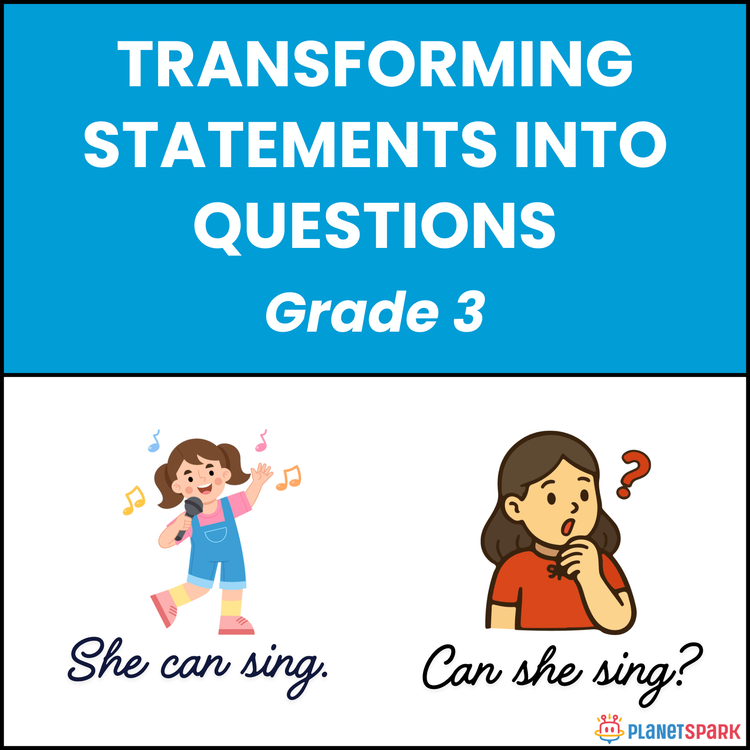
This Grade 3 worksheet helps students understand interrogative sentences—sentences that ask questions to gather information, clear doubts, or start conversations. Designed especially for young learners, it introduces how interrogative sentences often begin with words like who, what, where, when, why, how, can, or did and always end with a question mark. Through guided, step-by-step practice, students learn to identify questions, convert statements into questions, and confidently use interrogative sentences in everyday writing.
Why Interrogative Sentences Matter in Grammar?
Learning interrogative sentences is important for Grade 3 students because asking questions helps children become curious and active learners, interrogative sentences support classroom discussions and daily communication, they teach correct word order and punctuation using question marks, and understanding sentence types helps students choose the right way to express ideas and doubts.
What’s Inside This Worksheet?
This worksheet includes five well-structured activities to strengthen question-forming skills:
✏️ Exercise 1 – Identify Interrogative Sentences
Students read a mixed list of sentences and identify which ones are interrogative, learning to separate questions from statements, commands, and exclamations. Example: What time does the class begin?
🧠 Exercise 2 – Multiple Choice Identification
Students select the correct interrogative sentence or choose the correct sentence type, reinforcing recognition of proper question forms.
✍️ Exercise 3 – Sentence Rewriting
Learners rewrite word groups into correct interrogative sentences by fixing word order, adding helping verbs, and forming clear questions.
📝 Exercise 4 – Fill in the Blanks (Passage-Based)
Students complete a passage using suitable interrogative sentences, applying questions naturally in a real-life school context.
📖 Exercise 5 – Paragraph Writing
Students write a paragraph on My Birthday Celebration using interrogative sentences, encouraging expressive and thoughtful writing.
────────────────────────
ANSWER KEY
────────────────────────
Exercise 1 – Identify Interrogative Sentences
Interrogative sentences are:
3. How did the glass break?
4. Can you help me with this sum?
6. What time does the class begin?
9. Did you finish your homework?
Exercise 2 – Multiple Choice
1. a) This is an interrogative sentence.
2. a) Is Riya finishing her project?
3. a) This is a question.
4. c) When did the bus leave?
5. a) This is a question.
6. a) Can you close the window?
7. c) This is an interrogative sentence.
8. b) Why is Meera smiling today?
9. b) Is this your book? / c) Do you have your book?
10. c) Did Raj find his bag?
Exercise 3 – Sentence Rewriting (Sample Answers)
1. Is Riya going to school?
2. Is the boy reading a book?
3. Why are you late?
4. Where did you keep the bag?
5. Do you play after lunch?
6. When does the class start?
7. Why is the dog barking?
8. Did you see the notebook?
9. Why is Meera smiling?
10. Where is the bus stopping?
Exercise 4 – Fill in the Blanks (Sample Answers)
Where should I sit, How are you today, What lesson will we learn, Can you explain this again, Who will write first, What game should we play, What did you bring, When is the homework due, Do I have everything
Exercise 5 – Paragraph Writing
Answers may vary.
Help your child become a confident communicator by mastering interrogative sentences with this Grade 3 worksheet.
Frequently Asked Questions
An interrogative sentence asks a question and ends with a question mark.
By starting with question words like what, when, why, where, or how.
It improves questioning skills and supports better conversation and writing.