Grade 5 Editing: Countable vs Uncountable Nouns
Class 5EnglishEnglish GrammarFree DownloadPDF

Abshar AfrozVisit Profile
I am an enthusiastic English educator with a strong passion for helping students develop confidence in communication. At Planet Spark, I specialize in teaching Public Speaking and Creative Writing, guiding learners to express themselves clearly, think creatively, and speak with impact. Drawing on my teaching experience and warm, engaging style, I help children develop fluent English, powerful presentation skills, and a love for writing. My sessions are interactive, skill-focused, and designed to build both language proficiency and self-confidence in young minds.
Grade 5 Editing: Countable vs Uncountable Nouns
Class 5EnglishEnglish GrammarFree DownloadPDF
Abshar AfrozVisit Profile
I am an enthusiastic English educator with a strong passion for helping students develop confidence in communication. At Planet Spark, I specialize in teaching Public Speaking and Creative Writing, guiding learners to express themselves clearly, think creatively, and speak with impact. Drawing on my teaching experience and warm, engaging style, I help children develop fluent English, powerful presentation skills, and a love for writing. My sessions are interactive, skill-focused, and designed to build both language proficiency and self-confidence in young minds.
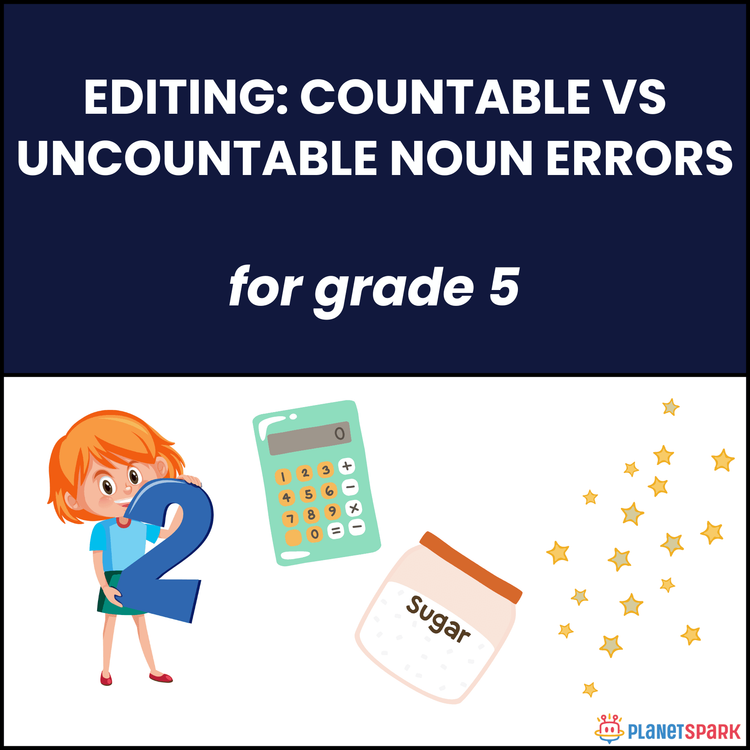
Grade 5 Worksheet: Editing: Countable vs Uncountable Noun Errors
This Grade 5 worksheet focuses on the distinction between countable and uncountable nouns, a key area where students often make mistakes. The worksheet helps students understand when to use "much" versus "many," as well as identifying common errors like "many water" or "much chairs." Through various exercises, students will practice selecting the correct word and form for countable and uncountable nouns.
The worksheet includes multiple-choice questions, fill-in-the-blanks, and paragraph editing exercises that challenge students to identify and fix errors involving countable and uncountable nouns in real-world contexts. By practicing these errors, students will gain confidence in using the correct forms and improve their writing fluency.
By the end of the worksheet, students will have a solid grasp on using countable and uncountable nouns correctly, enhancing both their grammar and communication skills.
Why Correct Use of Countable and Uncountable Nouns Matters in Grammar?
Mastering countable and uncountable nouns is crucial for writing clearly and correctly. For Grade 5 learners, this distinction is important because:
1. "Much" is used for uncountable nouns, and "many" is used for countable nouns.
2. Incorrect usage, such as "many water" or "much books," can make sentences sound awkward or incorrect.
3. Proper noun usage helps students express ideas more clearly and accurately.
4. Mastery of these concepts supports overall language development and writing skills.
This worksheet will guide students through recognizing and correcting these common errors.
What’s Inside This Worksheet?
This worksheet includes five activities designed to strengthen students' understanding of countable vs uncountable nouns:
🧠 Exercise 1 – Choose the Correct Phrase
Students choose the correct form (much or many) to complete sentences like "Please give me ______ water" or "We saw ______ birds in the garden."
✏️ Exercise 2 – Correct the Sentence
In this activity, students identify and correct errors in sentences involving uncountable and countable nouns.
📋 Exercise 3 – Write True or False
Students evaluate statements about the use of much/many to determine if they are correct or not.
🔤 Exercise 4 – Underline the Incorrect Word
Students underline and correct the misuse of much/many in sentences.
📝 Exercise 5 – Edit and Rewrite the Paragraph
In this final exercise, students will edit a paragraph that contains several errors involving countable and uncountable nouns.
✅ Answer Key (For Parents & Educators)
Exercise 1 – Choose the Correct Phrase
1. a) much water
2. b) many apples
3. b) much advice
4. b) many birds
5. a) much milk
6. b) many chairs
7. b) much sugar
8. a) many books
9. a) much homework
10. a) many students
Exercise 2 – Correct the Sentence
1. much information
2. much advice
3. many apples
4. many chairs
5. much milk
6. many homework
7. much books
8. many sugar
9. much pencils
10. many rice
Exercise 3 – Write True or False
1. True
2. True
3. False
4. True
5. False
6. True
7. True
8. False
9. True
10. False
Exercise 4 – Underline the Incorrect Word
1. much water → many water
2. many apples → much apples
3. much homework → many homework
4. many chairs → much chairs
5. much rice → many rice
6. much milk → many milk
7. many students → much students
8. much books → many books
9. many sugar → much sugar
10. much pencils → many pencils
Exercise 5 – Edit and Rewrite the Paragraph
1. Riya went to the market with her mother on Sunday morning. They bought much rice, much sugar, and much milk for the kitchen. The shopkeeper also gave them much advice about storing food properly. After coming home, Riya helped her mother arrange much furniture in the dining room and carried much water from the kitchen. Later, she ate many apples and much bread for breakfast. Her mother then asked her to write down much information about the groceries they needed for the next week.
Boost your child’s vocabulary and reading comprehension with engaging grammar worksheets designed to build real language confidence
🔖Book a free trial!
Frequently Asked Questions
Countable nouns are items that can be counted individually, such as books or apples, while uncountable nouns refer to substances or concepts like water or sugar that cannot be counted separately.
This rule helps students use correct quantity words such as many, much, few, and little. It also improves sentence accuracy in Class 5 English grammar writing tasks.
Students can sort nouns into categories, read sentences carefully, and correct errors using Class 5 English editing worksheets that focus on noun usage.