Class 3 Grammar Worksheet on Reducing Sentences
Class 3English GrammarEnglishFree DownloadPDF

Ramanjeet KaurVisit Profile
I am a content creator with a background in school teaching and educational content development. Having worked as a content creator with PlanetSpark, I specialize in developing engaging, age-appropriate learning materials that strengthen students’ English writing, grammar, and communication skills. I focus on clarity, creativity, and building confidence in young learners through structured and effective language instruction.
Class 3 Grammar Worksheet on Reducing Sentences
Class 3English GrammarEnglishFree DownloadPDF
Ramanjeet KaurVisit Profile
I am a content creator with a background in school teaching and educational content development. Having worked as a content creator with PlanetSpark, I specialize in developing engaging, age-appropriate learning materials that strengthen students’ English writing, grammar, and communication skills. I focus on clarity, creativity, and building confidence in young learners through structured and effective language instruction.
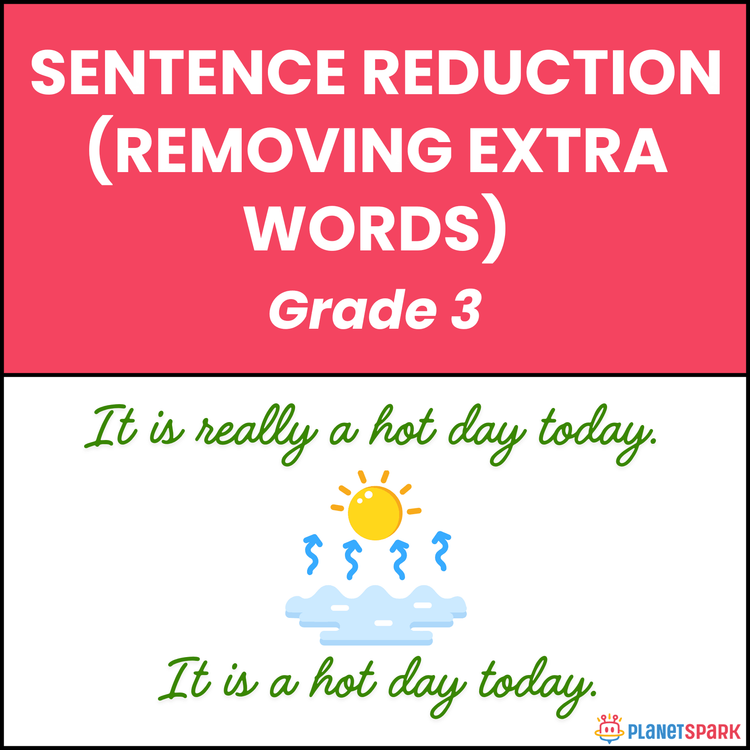
Sentence Reduction (Removing Extra Words) for Grade 3
This Grade 3 worksheet focuses on sentence reduction by helping students remove unnecessary or redundant words from sentences. Through a series of engaging exercises, learners will gain practical skills in making their sentences more concise and clearer, an essential skill for improving writing and communication. The exercises include identifying and eliminating extra words, selecting the most direct sentences, and rewriting wordy sentences to make them more effective.
Why Sentence Reduction Matters in Grammar?
Sentence reduction helps students improve their writing clarity:
1. It teaches them to eliminate unnecessary words which aids in making their writing concise, which is essential for both schoolwork and real-world communication.
2. It also strengthens comprehension as students focus on the key points in a sentence.
3. It helps Grade 3 students learn the importance of clarity in communication by identifying redundant words, choosing clear and concise sentences, and rewriting wordy sentences for improved clarity.
What’s Inside This Worksheet?
Exercise 1 – Underline the Words:
In this exercise, students are tasked with reading sentences and underlining the words that are redundant or repeat a meaning.
Exercise 2 – Multiple Choice Question:
Here, students are given three versions of a sentence, and they must choose the one that is the clearest and most concise.
Exercise 3 – Sentence Rewriting:
In this task, students are asked to rewrite each sentence by removing extra words. They must change the given sentences so that they are more direct and concise without altering the meaning.
Exercise 4 – Fill in the Blanks:
This exercise provides students with a passage where they need to choose the correct word from a set of options to complete each sentence.
Exercise 5 – Paragraph Writing:
In this final exercise, students are asked to write a short paragraph on the topic "My Favourite Food".
These tasks help students understand the importance of clarity in communication, teaching them how to express ideas in a more concise and effective way. They will learn to eliminate redundancy and identify filler words, an essential aspect of mastering language.
Answer Key (For Parents and Educators)
Exercise 1 – Underline the Words (Extra Words)
1. in size
2. actually
3. in colour
4. together
5. really
6. again
7. in the morning
8. in weight
9. final
10. high
Exercise 2 – Choose the Best Sentence
1. b) The ball was round.
2. a) I finished my project.
3. c) It is cold outside.
4. b) He gave me a gift.
5. a) Two cats are sitting on the mat.
6. c) The mango was sweet.
7. b) The farmer planted rice.
8. b) The puppy barked loudly.
9. c) The shopkeeper sells milk.
10. a) The kite flew high in the sky.
Exercise 3 – Rewrite Each Sentence
1. It was a fact that it rained.
2. My plans are to go to the park.
3. The apple was red.
4. The baker baked a sweet cake.
5. We must join to play the game.
6. The grass was green.
7. I will write a short note.
8. The painter drew a picture of kite./ The painter drew a kite.
9. The sun was hot.
10. The rain fell from the sky.
Exercise 4 – Fill in the Blanks
1. blue
2. history
3. each
4. outcome
5. large
6. circle
7. built
8. summary
9. innovation
Exercise 5 – Paragraph Writing
Answers may vary.
Help your child master sentence structure and improve their writing skills with a Free 1:1 English Trial Class at PlanetSpark.
Frequently Asked Questions
Sentences can be reduced by removing unnecessary words or combining ideas more concisely.
If a sentence feels long or repetitive, consider simplifying it without losing meaning.
It improves clarity and makes writing more efficient and to the point.