Class 3 Worksheet on Dialogue with Quotation Marks
Class 3EnglishEnglish GrammarFree DownloadPDF

Masarrath NaziaVisit Profile
I am a passionate educator with over 5 years of experience teaching English and public speaking skills. I create supportive, engaging learning environments that help students grow both academically and personally.
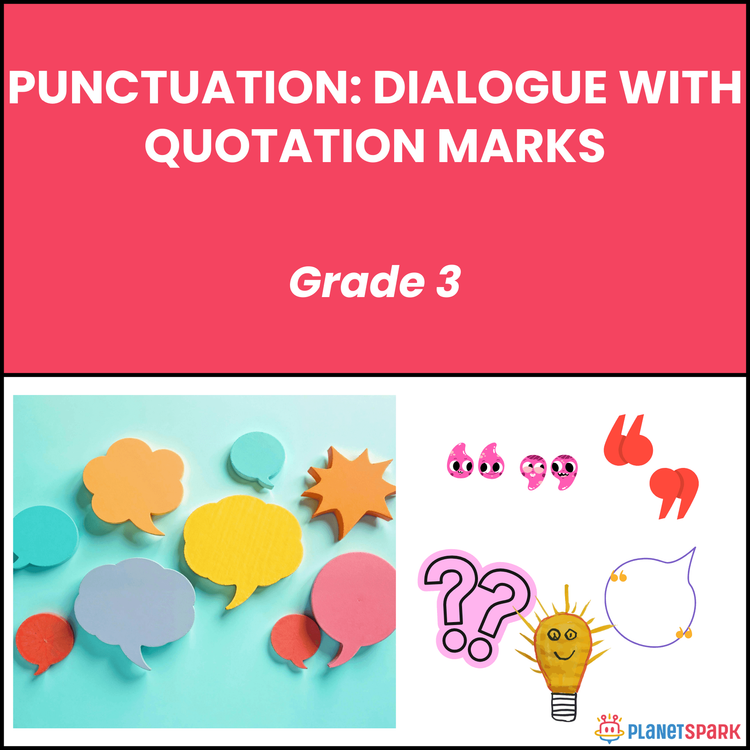
Class 3 Worksheet on Dialogue with Quotation Marks
Class 3EnglishEnglish GrammarFree DownloadPDF
Masarrath NaziaVisit Profile
I am a passionate educator with over 5 years of experience teaching English and public speaking skills. I create supportive, engaging learning environments that help students grow both academically and personally.
Dialogue with Quotation Marks for Class 3
This Grade 3 English grammar worksheet helps students learn how to use quotation marks correctly while writing dialogue. It focuses on punctuating spoken words using quotation marks, commas, capital letters, and question marks so that conversations are clear and grammatically correct in writing.
Through structured and age-appropriate practice, students understand how sentences change when someone is speaking, how questions are written inside quotation marks, and how reporting verbs like said and asked are used. The worksheet supports foundational punctuation skills essential for accurate sentence writing.
The worksheet includes multiple skill-building tasks such as choosing the correct dialogue sentence, identifying correct and incorrect punctuation, filling in missing dialogue punctuation, rewriting sentences with quotation marks, and completing a short dialogue-based paragraph. These activities improve sentence structure, reading comprehension, and writing confidence—useful for school exams and grammar practice.
Why Quotation Marks Matter in Grammar?
Understanding quotation marks is important for Grade 3 learners because:
1. They show exactly what a person is saying in a sentence.
2. They help students use commas, capital letters, and question marks correctly in dialogue.
3. They improve clarity and meaning in written conversations.
4. They prepare students for story writing and paragraph construction.
What’s Inside This Worksheet?
This worksheet includes five grammar-rich activities that build fluency with dialogue punctuation:
🧠 Exercise 1 – Multiple Choice Questions
Students choose the sentence that uses quotation marks and dialogue punctuation correctly.
✏️ Exercise 2 – True or False
Students decide whether each sentence uses quotation marks correctly.
🔤 Exercise 3 – Fill in the Blanks
Students add correct quotation marks and choose the correct reporting verb (said/asked).
🖊️ Exercise 4 – Sentence Rewriting
Students rewrite sentences by adding quotation marks and correcting punctuation.
📝 Exercise 5 – Paragraph Writing
Students complete a short paragraph by filling in missing dialogue punctuation.
✅ Answer Key (For Parents & Educators)
Exercise 1 – Multiple Choice Questions
1. b 2. b 3. c 4. b 5. c
6. b 7. c 8. c 9. a 10. a
Exercise 2 – True or False
1. True 2. True 3. False 4. True 5. False
6. False 7. True 8. True 9. True 10. True
Exercise 3 – Fill in the Blanks
1. Riya said, "I see dark clouds."
2. Ravi asked, "Is it my turn?"
3. Meera said, "This bag is heavy."
4. Asha asked, "Can we sit here?"
5. Raj said, "The whistle blew."
6. The umpire said, "Play fair."
7. Mother asked, "Did you call her?"
8. Father said, "Lock the door."
9. The driver asked, "All ready?"
10. The child said, "I feel scared."
Exercise 4 – Sentence Rewriting
1. Riya said, "I like mangoes."
2. Meera said, "I am learning Hindi."
3. Asha asked, "Can we start the drawing?"
4. Ravi asked, "Are we going to play cricket?"
5. Raj said, "I won the race."
6. The teacher said, "Open your notebook."
7. Mother asked, "Did you eat your lunch?"
8. Father said, "Finish your homework."
9. The boy said, "I feel sleepy."
10. The girl asked, "May I come inside?"
Exercise 5 – Paragraph Writing (Sample Answer)
The teacher entered the classroom and said, "Good morning, children."
The students replied, "Good morning, ma’am."
Rohan raised his hand and asked, "May I drink water?"
The teacher smiled and said, "Yes, you may."
Sita whispered, "This story is interesting."
When the bell rang, the teacher said, "Keep your books inside the bag."
Rohan laughed and said, "School is fun today."
Sita replied, "I enjoy learning new things."
Build strong punctuation skills and help your child write clear and confident conversations with this Grade 3 dialogue worksheet.
Frequently Asked Questions
Quotation marks are punctuation marks used to show the exact words spoken by a character, making conversations clear to the reader.
Commas and periods are usually placed inside the quotation marks in English, such as in “I’m ready,” she said.
Students often forget to close quotation marks, place punctuation outside the marks, or confuse dialogue with narration.