Class 5 Comparing Two Ideas Using Than Worksheet
Class 5EnglishEnglish GrammarFree DownloadPDF

Archita SrivastavaVisit Profile
I am a lively and dynamic educator with four years of teaching experience across online and offline classrooms. I began my journey as a private tutor for three years and currently work as a Public Speaking Expert at PlanetSpark. I have taught students up to high school in CBSE, ICSE, and UP Board, covering all major subjects while guiding them through board exam projects and assignments with creativity, confidence, and a joyful learning spirit. My aim is to build confident speakers and motivated learners who grow with curiosity and joy.
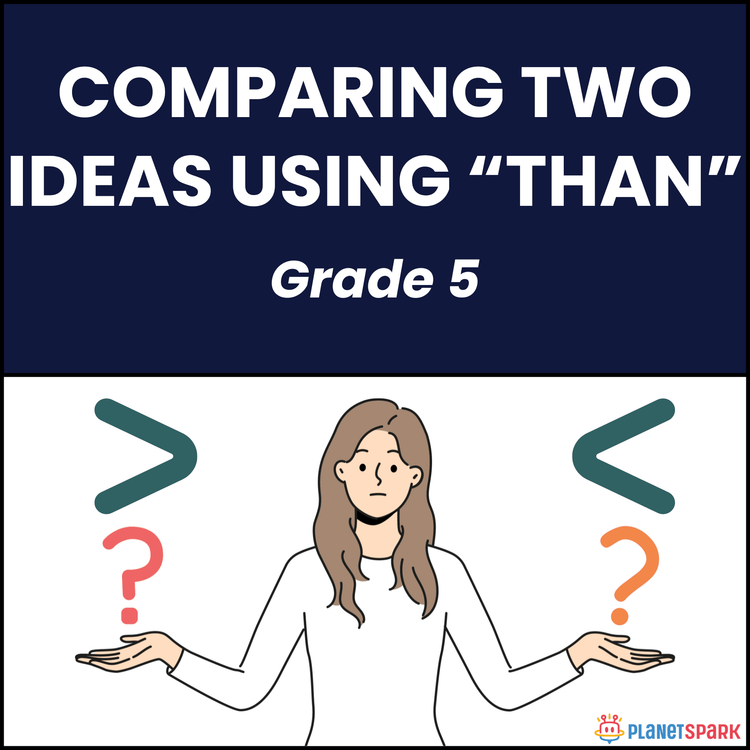
Class 5 Comparing Two Ideas Using Than Worksheet
Class 5EnglishEnglish GrammarFree DownloadPDF
Archita SrivastavaVisit Profile
I am a lively and dynamic educator with four years of teaching experience across online and offline classrooms. I began my journey as a private tutor for three years and currently work as a Public Speaking Expert at PlanetSpark. I have taught students up to high school in CBSE, ICSE, and UP Board, covering all major subjects while guiding them through board exam projects and assignments with creativity, confidence, and a joyful learning spirit. My aim is to build confident speakers and motivated learners who grow with curiosity and joy.
Bigger, Better, Faster: Comparing Two Ideas Using "Than" for Class 5
This Grade 5 worksheet helps students master the use of "than" in comparative sentences. Through five well-structured exercises — multiple choice questions, fill in the blanks, match the following, underline the incorrect word, and paragraph writing — students learn to correctly compare two ideas using comparative adjectives and the word "than" in meaningful, real-life contexts.
Why Comparing Two Ideas Using "Than" Matters in Grammar?
Using "than" correctly is a fundamental skill in Grade 5 English grammar because:
1. It helps students make clear and accurate comparisons between two people, places, or things.
2. It teaches the difference between "than" (used in comparisons) and "then" (used for time sequences).
3. It builds the ability to use comparative adjectives like taller, faster, and more crowded accurately.
4. It strengthens both written and spoken communication by making ideas more precise and expressive.
What's Inside This Worksheet?
This worksheet includes five grammar-rich activities that develop strong comparative language skills:
Exercise 1 – Multiple Choice Questions
Students choose the correct comparative word or phrase from three options to complete each sentence. This task helps students distinguish between "more," "most," "than," "then," and "that" in comparative structures. Example: "Delhi is __________ crowded than Jaipur." → more.
Exercise 2 – Fill in the Blanks (Word Pairs)
Students are given a pair of comparative words (e.g., than / then) and must choose the correct one to complete the sentence. This exercise builds accuracy in using comparison words appropriately with different types of adjectives.
Exercise 3 – Match the Following
Students match each incomplete sentence on the left to the correct comparative word on the right. This activity reinforces understanding of when to use "than" versus "more" in a comparison.
Exercise 4 – Underline the Incorrect Comparison Word
Each sentence contains an incorrect comparative word. Students identify and underline it, sharpening their proofreading and error-correction skills.
Exercise 5 – Paragraph Writing
Students fill in the blanks within a connected paragraph using the correct comparison words. This exercise integrates all the skills practised earlier into a fluent writing context.
Answer Key (For Parents & Educators)
Exercise 1 – Multiple Choice Questions
1. c) more
2. c) than
3. a) more
4. b) than
5. b) more
6. a) more
7. a) more
8. c) than
9. a) more
10. b) much
Exercise 2 – Fill in the Blanks
1. than
2. more
3. than
4. more
5. than
6. more
7. than
8. less
9. than
10. than
Exercise 3 – Match the Following
1. than
2. more
3. than
4. more
5. than
6. more
7. than
8. more
9. than
10. than
Exercise 4 – Underline the Incorrect Comparison Word
1. then (should be: than)
2. then (should be: than)
3. most (should be: more)
4. then (should be: than)
5. much (should be: more)
6. most (should be: more)
7. much (should be: more)
8. then (should be: than)
9. most (should be: more)
10. most (should be: more)
Exercise 5 – Paragraph Writing
1. than
2. than
3. more
4. more
5. than
6. than
7. more
8. than
9. more
10. than
11. than
Give your child the gift of clear communication — join a Free 1:1 English Grammar Trial Class at PlanetSpark now!
Frequently Asked Questions
“Than” connects two ideas when comparing people, objects, or actions.
Some learners confuse “than” with “then,” which has a completely different meaning.
Students use "than" to show how one thing is different from another, like "She is taller than him." It's used with comparatives to explain differences in size, quality, or other attributes.