Class 2 Converting Statements to Questions Worksheet
Class 2English GrammarEnglishFree DownloadPDF

Ramanjeet KaurVisit Profile
I am a content creator with a background in school teaching and educational content development. Having worked as a content creator with PlanetSpark, I specialize in developing engaging, age-appropriate learning materials that strengthen students’ English writing, grammar, and communication skills. I focus on clarity, creativity, and building confidence in young learners through structured and effective language instruction.
Class 2 Converting Statements to Questions Worksheet
Class 2English GrammarEnglishFree DownloadPDF
Ramanjeet KaurVisit Profile
I am a content creator with a background in school teaching and educational content development. Having worked as a content creator with PlanetSpark, I specialize in developing engaging, age-appropriate learning materials that strengthen students’ English writing, grammar, and communication skills. I focus on clarity, creativity, and building confidence in young learners through structured and effective language instruction.
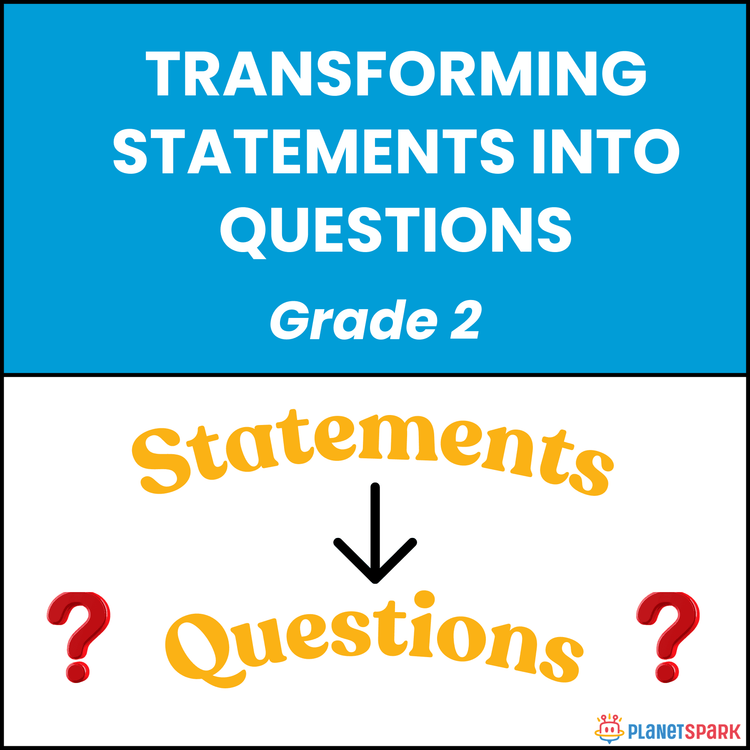
Questions in Action: Turning Statements into Questions for Class 2
This Grade 2 grammar worksheet focuses on helping young learners understand how to convert simple statements into correct and meaningful questions. Through guided and structured practice, students learn how questions are formed using appropriate helping verbs and correct sentence order.
The worksheet covers the grammar topic “Converting Statements into Questions” and introduces the use of auxiliary verbs such as do, does, did, is, are, am, was, were, has, have, can, and will. These are presented through simple, child-friendly sentences that match the Grade 2 learning level.
Why Converting Statements into Questions Matters in Grammar?
Learning how to change statements into questions is an essential grammar skill for Grade 2 students because:
1. It helps children understand sentence structure and word order.
2. It builds correct usage of helping verbs in present, past, and future tense.
3. It improves spoken English by teaching how to ask clear and correct questions.
4. It strengthens reading comprehension and everyday communication skills.
What’s Inside This Worksheet?
This worksheet includes multiple engaging grammar activities designed to build confidence and accuracy in question formation:
Exercise 1 – Underline the Correct Word
Students choose and underline the correct helping verb to turn a sentence into a proper question.
Exercise 2 – Choose the Correct Question
Students read a statement and select the correctly framed question from multiple options, reinforcing tense and verb agreement.
Exercise 3 – Rewrite Statements as Questions
Students rewrite given statements into questions, helping them practice sentence transformation independently.
Exercise 4 – Fill in the Blanks (Story-Based)
A short passage encourages students to complete questions using suitable helping verbs, making grammar learning contextual and engaging.
Exercise 5 – Paragraph Writing
Students write a short paragraph on “A Trip to the Zoo,” allowing them to apply sentence construction skills creatively.
Answer Key (For Parents and Educators)
Exercise 1 – Underline the Correct Word
1. Does
2. Are
3. Do
4. Can
5. Did
6. Are
7. Does
8. Am
9. Will
10. Has
Exercise 2 – Choose the Correct Question
1. c) Do the kites fly in the sky?
2. b) Does Aarav read a story?
3. a) Will Mohit leave next month?
4. c) Did Kabir paint a picture?
5. a) Are the mangoes ripe?
6. b) Is Isha eating a chocolate?
7. a) Have you plucked the flower?
8. b) Were they very happy?
9. c) Can we start the work now?
10. a) Am I ready for the test?
Exercise 3 – Rewrite the Sentences as Questions
1. Does mom water the plants?
2. Are the boys playing cricket?
3. Did Asha find a pebble?
4. Does the teacher read a story?
5. Have the children painted pictures?
6. Do we feed the dog?
7. Was the window closed?
8. Is Sonia jumping high?
9. Is the train on time?
10. Do the children laugh loudly?
Exercise 4 – Fill in the Blanks
1. Do
2. Is
3. Do
4. Is
5. Is
6. Are
7. Can
Exercise 5 – Paragraph Writing
Answers may vary.
Help your child master question formation and communicate confidently in English.
Frequently Asked Questions
Statements provide information, while questions ask for it, often requiring inversion of subject and auxiliary verb.
Exercises encourage children to change declarative sentences into interrogative ones, reinforcing grammar rules.
It enhances comprehension, conversational skills, and prepares students for CBSE English sentence structures.