Class 5 Irregular Adjectives Comparison Worksheet
Class 5EnglishEnglish GrammarFree DownloadPDF

Archita SrivastavaVisit Profile
I am a lively and dynamic educator with four years of teaching experience across online and offline classrooms. I began my journey as a private tutor for three years and currently work as a Public Speaking Expert at PlanetSpark. I have taught students up to high school in CBSE, ICSE, and UP Board, covering all major subjects while guiding them through board exam projects and assignments with creativity, confidence, and a joyful learning spirit. My aim is to build confident speakers and motivated learners who grow with curiosity and joy.
Class 5 Irregular Adjectives Comparison Worksheet
Class 5EnglishEnglish GrammarFree DownloadPDF
Archita SrivastavaVisit Profile
I am a lively and dynamic educator with four years of teaching experience across online and offline classrooms. I began my journey as a private tutor for three years and currently work as a Public Speaking Expert at PlanetSpark. I have taught students up to high school in CBSE, ICSE, and UP Board, covering all major subjects while guiding them through board exam projects and assignments with creativity, confidence, and a joyful learning spirit. My aim is to build confident speakers and motivated learners who grow with curiosity and joy.
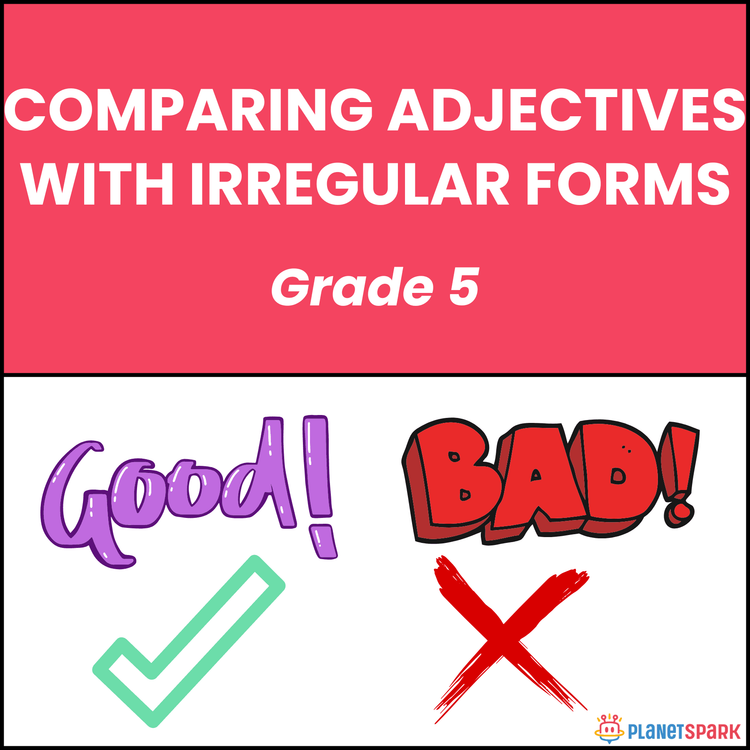
Better, Best, Farthest: Comparing Adjectives with Irregular Forms for Class 5
This Grade 5 worksheet focuses on one of the trickiest and most important grammar topics — comparing adjectives with irregular forms. Unlike regular adjectives that follow predictable patterns, irregular adjectives like good, bad, and far change completely in their comparative and superlative forms: good → better → best, bad → worse → worst, far → farther → farthest. This worksheet helps students master these forms through five engaging and well-structured activities that move from recognition to application.
Why Comparing Adjectives with Irregular Forms Matters in Grammar?
Irregular comparison forms are a key part of fluent English usage. For Grade 5 learners, this topic is important because:
1. Regular adjectives use -er/-est or more/most, but irregular ones follow entirely different patterns.
2. The three main irregular adjectives covered are good, bad, and far.
3. Using the wrong form (e.g., "more better" or "worser") is a very common error that this worksheet corrects.
4. These forms appear frequently in both formal writing and everyday speech.
5. Understanding superlatives vs. comparatives builds clearer and more expressive sentences.
What's Inside This Worksheet?
This worksheet includes five grammar-rich activities that build mastery of irregular comparison forms:
Exercise 1 – Multiple Choice Questions
Students choose the correct comparative or superlative form of an irregular adjective from three options. This builds their instinct for identifying which form fits — better vs. best, worse vs. worst, farther vs. farthest.
Exercise 2 – Fill in the Blanks (Choose One from a Pair)
Students select the more appropriate irregular comparison form from a given pair to complete each sentence meaningfully. This helps them distinguish between comparative and superlative usage in context.
Exercise 3 – Match the Following
Students match each sentence to the correct comparison form from a list on the right, reinforcing their understanding of when to use comparative vs. superlative forms.
Exercise 4 – Underline the Incorrect Comparison Form
Students read each sentence and underline the incorrect comparison form. This error-spotting task helps them recognize common mistakes like "more better," "worser," and "more far."
Exercise 5 – Paragraph Writing with Irregular Comparison Forms
Students fill in blanks in a connected paragraph with suitable irregular comparison forms. This activity challenges students to apply all three adjective sets — good/better/best, bad/worse/worst, far/farther/farthest — in a natural writing context.
Answer Key (For Parents & Educators)
Exercise 1 – Multiple Choice Questions
1. b) better
2. c) best
3. a) better
4. b) farther
5. c) best
6. b) worse
7. a) farther
8. c) best
9. b) worse
10. c) farthest
Exercise 2 – Fill in the Blanks
1. better
2. best
3. farther
4. better
5. best
6. worse
7. farthest
8. best
9. worse
10. farthest
Exercise 3 – Match the Following
1. better
2. best
3. farther
4. worse
5. worst
6. farthest
7. best
8. worse
9. worst
10. farther
Exercise 4 – Underline the Incorrect Comparison Form
1. more better (incorrect — should be "better")
2. good (incorrect — should be "best")
3. worser (incorrect — should be "worse")
4. more farther (incorrect — should be "farther")
5. better (incorrect — should be "best")
6. more bad (incorrect — should be "worse")
7. farther (incorrect — should be "farthest")
8. good (incorrect — should be "best")
9. more worse (incorrect — should be "worse")
10. more far (incorrect — should be "farther")
Exercise 5 – Paragraph Writing (Sample Answers)
Blank 1: better
Blank 2: best
Blank 3: farther
Blank 4: better
Blank 5: worse
Blank 6: better
Blank 7: best
Blank 8: farthest
Blank 9: worse
Blank 10: best
Help your child compare with confidence — sign them up for a Free 1:1 English Grammar Trial Class at PlanetSpark and watch their language skills go from good to best.
Frequently Asked Questions
Irregular adjectives like good, bad, and far change form differently when making comparisons.
Because they do not follow the normal “-er” or “more” comparison rules in English grammar.
Irregular adjective comparisons change their form instead of just adding "er" or "est." For example, "good" becomes "better" and "best," while "bad" becomes "worse" and "worst."