Class 2 English Worksheet on Adjectives and Adverbs
Class 2English GrammarEnglishFree DownloadPDF

Paridhi SharmaVisit Profile
I am an English learning facilitator for young learners, focused on helping kids build strong language foundations through fun, simple, and engaging activities designed to make learning enjoyable and effective.
Class 2 English Worksheet on Adjectives and Adverbs
Class 2English GrammarEnglishFree DownloadPDF
Paridhi SharmaVisit Profile
I am an English learning facilitator for young learners, focused on helping kids build strong language foundations through fun, simple, and engaging activities designed to make learning enjoyable and effective.
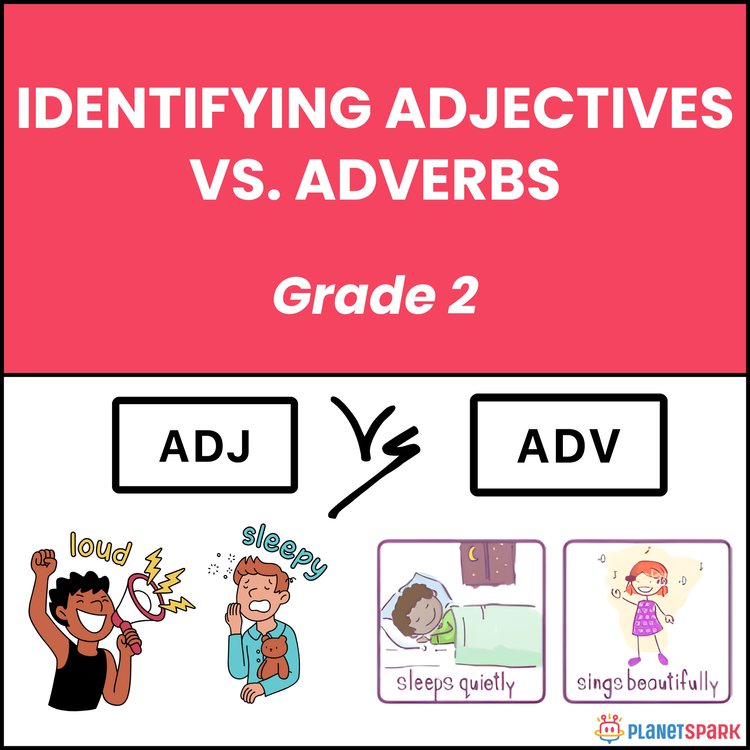
Word Power in Action: Identifying Adjectives and Adverbs for Class 2
This Class 2 worksheet helps young learners clearly understand the difference between adjectives and adverbs through simple, real-life sentence practice. Designed especially for early grammar learners, it teaches children how adjectives describe nouns and how adverbs tell us more about actions. With familiar examples from school, home, and everyday activities, students learn to choose the right word that makes each sentence meaningful and correct. The worksheet includes a variety of engaging tasks such as multiple-choice questions, fill-in-the-blanks, matching exercises, error-spotting, and paragraph completion. These activities guide learners from basic identification to confident application, helping them avoid common mistakes like mixing describing words with action words. It is ideal for classroom reinforcement, homework practice, or grammar revision at home.
Why Adjectives and Adverbs Matter in Grammar?
Understanding adjectives and adverbs is important for Grade 2 learners because:
1. Adjectives describe nouns and help children add detail to people, places, and things.
2. Adverbs describe actions and explain how something happens.
3. Knowing the difference improves sentence clarity and correctness.
4. It helps children write and speak more clearly and confidently.
What’s Inside This Worksheet?
This worksheet includes five carefully designed grammar exercises:
Exercise 1 – Multiple Choice Questions
Students choose the correct adjective or adverb to complete each sentence meaningfully.
Exercise 2 – Fill in the Blanks (Word Pairs)
Learners select the correct word from adjective–adverb pairs to complete sentences.
Exercise 3 – Match the Following
Students match each sentence with the correct adjective or adverb from a word pool.
Exercise 4 – Underline the Incorrect Word
Children underline the adjective or adverb that is incorrect in each sentence.
Exercise 5 – Paragraph Completion
Learners fill in suitable adjectives and adverbs to complete a short paragraph about a school day.
ANSWER KEY (For Parents & Educators)
Exercise 1 – Multiple Choice Questions
1. quickly
2. big
3. loudly
4. small
5. loudly
6. neat
7. slowly
8. small
9. loudly
10. neat
Exercise 2 – Fill in the Blanks
1. loudly
2. big
3. neatly
4. big
5. quietly
6. small
7. slowly
8. quiet
9. quickly
10. small
Exercise 3 – Match the Following
1. quietly
2. big
3. quickly
4. softly
5. small
6. slowly
7. big
8. neatly
9. quiet
10. loudly
Exercise 4 – Underline the Incorrect Word
1. quiet
2. loud
3. quick
4. slow
5. loudly
6. slow
7. neat
8. soft
9. neat
10. quiet
Exercise 5 – Paragraph Writing (Sample Answers – Students may vary)
loud, slowly, small, softly, neat, quietly, soft, neatly
Help your child describe actions and objects correctly with focused grammar practice that builds strong language foundations. Support confident writing and speaking with expert guidance at PlanetSpark.
🔖Book a free trial!
Frequently Asked Questions
Adjectives describe nouns, while adverbs describe verbs, adjectives, or other adverbs.
They look for words that explain how, when, or where an action happens, such as quickly or today.
Many adverbs end in -ly, but not all do, so students must focus on the function in the sentence.