Class 2 English Worksheet on Adjectives of Number
Class 2English GrammarEnglishFree DownloadPDF

Sumaiya ManiyarVisit Profile
I am a dedicated educator and mentor with experience in public speaking, creative writing, and communication skills development. Currently associated with PlanetSpark, I work closely with students across age groups to build confidence, critical thinking, and expressive clarity through structured and engaging learning methods.
Class 2 English Worksheet on Adjectives of Number
Class 2English GrammarEnglishFree DownloadPDF
Sumaiya ManiyarVisit Profile
I am a dedicated educator and mentor with experience in public speaking, creative writing, and communication skills development. Currently associated with PlanetSpark, I work closely with students across age groups to build confidence, critical thinking, and expressive clarity through structured and engaging learning methods.
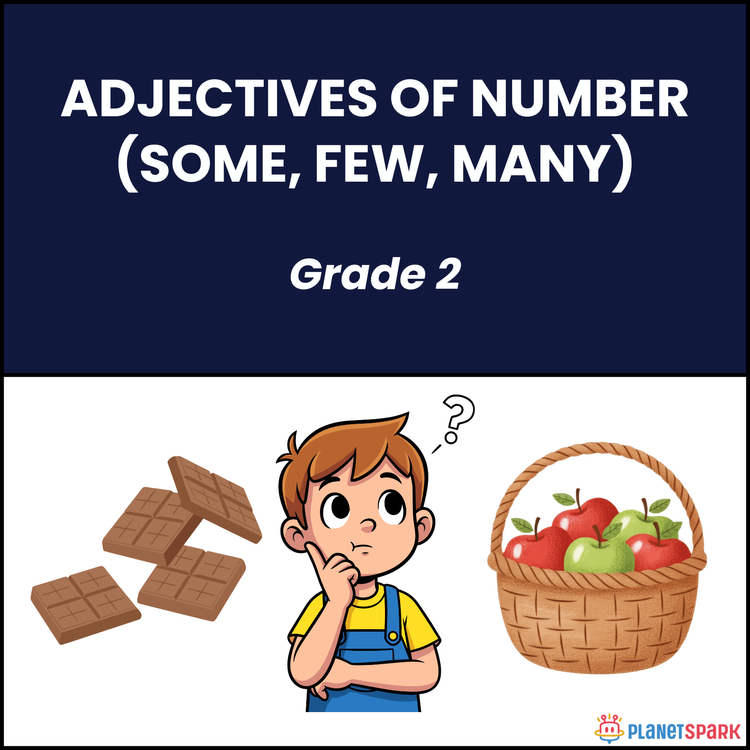
Counting with Clarity: Adjectives of Number (Some, Few, Many) for Class 2
This Grade 2 English grammar worksheet focuses on helping young learners understand and correctly use adjectives of number such as some, few, and many in everyday sentences. Designed specially for primary students, it introduces quantity words in a simple, relatable, and age-appropriate manner.
Through a mix of multiple-choice questions, fill-in-the-blanks, matching activities, underlining tasks, and paragraph writing, children learn how adjectives of number change meaning based on context. Each exercise encourages students to observe sentence clues and choose the most suitable word to describe quantity.
This worksheet strengthens grammar foundations by connecting language rules to real-life situations like sharing food, counting objects, or describing groups. It supports classroom teaching, homework practice, and revision while building confidence in sentence construction and reading comprehension.
Why Adjectives of Number Matter in Grammar?
Adjectives of number help children talk clearly about quantity. For Grade 2 learners, this topic is important because:
1. It teaches them to describe how many things are there.
2. It improves sentence meaning and clarity.
3. It supports reading comprehension and writing accuracy.
4. It builds a strong base for advanced grammar topics.
What’s Inside This Worksheet?
This worksheet includes five engaging grammar activities:
🧠 Exercise 1 – Multiple Choice Questions
Students choose the correct adjective of number (some, few, many) to complete each sentence.
✏️ Exercise 2 – Fill in the Blanks (Option Pairs)
Students select the correct word from a given pair to complete each sentence meaningfully.
📋 Exercise 3 – Match the Following
Students match sentences to the correct adjective of number from a shuffled list.
📝 Exercise 4 – Underline the Incorrect Word
Students identify and underline the wrong adjective of number used in each sentence.
📖 Exercise 5 – Paragraph Writing
Students complete a short paragraph using suitable adjectives of number, applying learning in context.
✅ Answer Key (For Parents & Educators)
Exercise 1 – Multiple Choice
1. some
2. few
3. many
4. many
5. few
6. many
7. few
8. some
9. many
10. some
Exercise 2 – Fill in the Blanks (Option Pairs)
1. many
2. few
3. some
4. many
5. many
6. many
7. some
8. few
9. many
10. some
Exercise 3 – Match the Following
1. many
2. few
3. some
4. few
5. many
6. some
7. many
8. some
9. few
10. many
Exercise 4 – Underline the Incorrect Word
1. many
2. some
3. few
4. some
5. many
6. few
7. some
8. many
9. few
10. many
Exercise 5 – Paragraph Writing
Answers may vary.
Help your child confidently describe quantities and strengthen grammar skills with expert-led learning support.
Frequently Asked Questions
Adjectives of number tell how many people or things are being talked about, such as some, few, or many.
Children mix them up because some shows an indefinite amount, few means almost none, and many shows a large number.
By using daily examples like counting toys, snacks, or books to show when to use some, few, and many.