Class 2 English Worksheet on Geography and Space Basics
Class 2EnglishEnglish GrammarFree DownloadPDF

Kanishka ModiVisit Profile
I’m an enthusiastic educator with 4 years of experience teaching English, communication skills, and personality development. I’ve guided ICSE, CBSE, and IB students through interactive and practical learning, focusing on building confidence and effective expression. My teaching integrates child psychology principles to create a nurturing and engaging classroom experience.
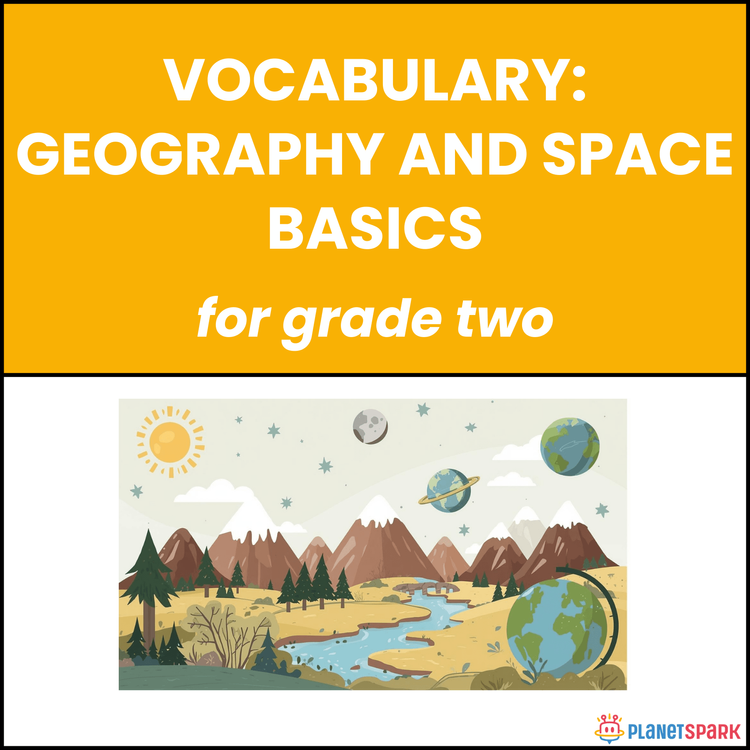
Class 2 English Worksheet on Geography and Space Basics
Class 2EnglishEnglish GrammarFree DownloadPDF
Kanishka ModiVisit Profile
I’m an enthusiastic educator with 4 years of experience teaching English, communication skills, and personality development. I’ve guided ICSE, CBSE, and IB students through interactive and practical learning, focusing on building confidence and effective expression. My teaching integrates child psychology principles to create a nurturing and engaging classroom experience.
From Earth to Space: Geography and Space Basics for Class 2
This Class 2 worksheet introduces young learners to basic geography and space concepts in a simple, engaging way. Through clear multiple-choice questions, students learn about continents, oceans, countries, planets, and space objects. The activities build curiosity about the Earth and the universe while strengthening vocabulary, general knowledge, and reading comprehension skills.
Why Geography and Space Basics Matter in Grammar?
This worksheet helps learners:
1. Identify continents, oceans, and countries correctly.
2. Understand basic map and world concepts used in early geography.
3. Learn simple space-related vocabulary such as planets, stars, and the Moon.
4. Build curiosity and confidence in talking about the world and space around them.
What’s Inside This Worksheet?
This worksheet includes three knowledge-rich vocabulary activities:
Exercise 1 – Continents and Oceans
Students answer questions about continents and oceans, learning facts like Asia is the largest continent, Australia is the smallest continent, and the Pacific Ocean is the largest ocean.
Exercise 2 – World Geography Facts
Learners explore geography facts such as continents near the Equator, oceans near the poles, and continents known for deserts or animals like kangaroos.
Exercise 3 – Space Basics
Students identify space-related words such as Moon, telescope, Mars, Jupiter, astronaut, and space, building foundational astronomy vocabulary.
✅ Answer Key (For Parents & Educators)
Exercise 1 – Continents and Oceans
1. Asia
2. Asia
3. Indian Ocean
4. India
5. Antarctica
6. Pacific
7. Pacific Ocean
8. China
9. Australia
10. Asia
Exercise 2 – World Geography Facts
1. Australia
2. Asia
3. Africa
4. Africa
5. Seven
6. Indian Ocean
7. Antarctica
8. Arctic Ocean
9. Arctic Ocean
10. Australia
Exercise 3 – Space Basics
1. Moon
2. Telescope
3. Sky
4. Mars
5. Space
6. Jupiter
7. Astronaut
8. Earth
9. Star
10. Moon
Help your child explore the Earth and beyond while building strong vocabulary and general awareness through fun geography and space learning.
🔖Book a free trial!
Frequently Asked Questions
The worksheet introduces landforms, directions, Earth, and basic space terms.
Because concepts are abstract, so guided language support is needed.
By using age-appropriate words, pictures, and examples.